
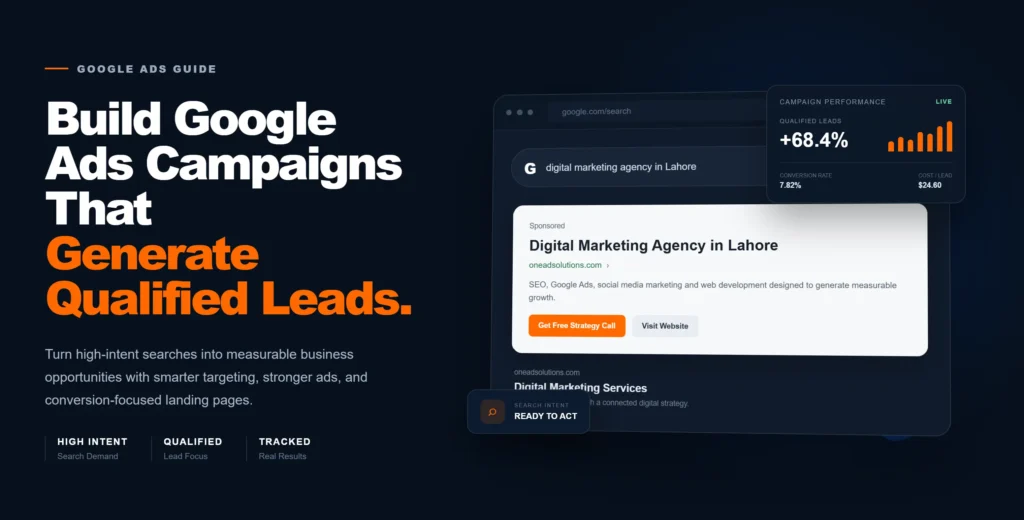
Paid search can give businesses something organic marketing often cannot provide immediately: access to people who are already searching for a product, service, or solution.
Someone searching for “digital marketing agency in Lahore” is fundamentally different from someone casually scrolling through social media and seeing a digital marketing advertisement.
The search itself communicates intent.
But that doesn’t mean every Google Ads campaign automatically produces results.
Businesses can spend significant amounts of money generating clicks without generating enough qualified leads or sales. The difference usually comes down to how well the campaign connects search intent, targeting, advertising, landing pages, conversion tracking, and ongoing optimization.
At One Ad Solutions, we approach paid advertising as part of a broader digital marketing system rather than an isolated traffic source. Google Ads can capture existing demand, while SEO, website development, content, social media, and creative assets can help build and convert that demand across the customer journey.
This guide explains how businesses can build Google Ads campaigns around that principle.
1. What Is Google Ads and How Does It Work?
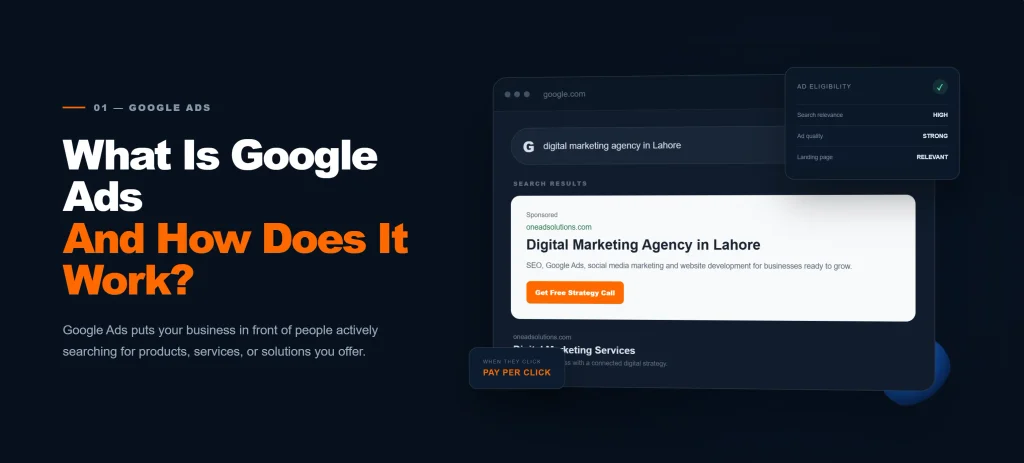
Google Ads is Google’s advertising platform that allows businesses to display paid advertisements across Google’s search results and other properties.
For search campaigns, advertisers typically bid on keywords or search themes relevant to their products or services. When someone performs a relevant search, Google determines which ads are eligible to appear and how they should be positioned.
The advertiser generally pays when someone interacts with the advertisement, such as clicking it.
But the important part isn’t simply appearing in search results.
The real objective is to appear when the right person is searching for the right thing.
For example, a business selling commercial solar systems would usually gain more value from reaching someone searching for “commercial solar installation company” than someone searching for a broad informational topic with no clear buying intent.
This is why campaign strategy matters.
Google Ads can provide fast visibility, but the quality of that visibility depends on targeting and relevance.
→ Explore our Google Ads Services.
2. Why Search Intent Makes Google Ads Powerful
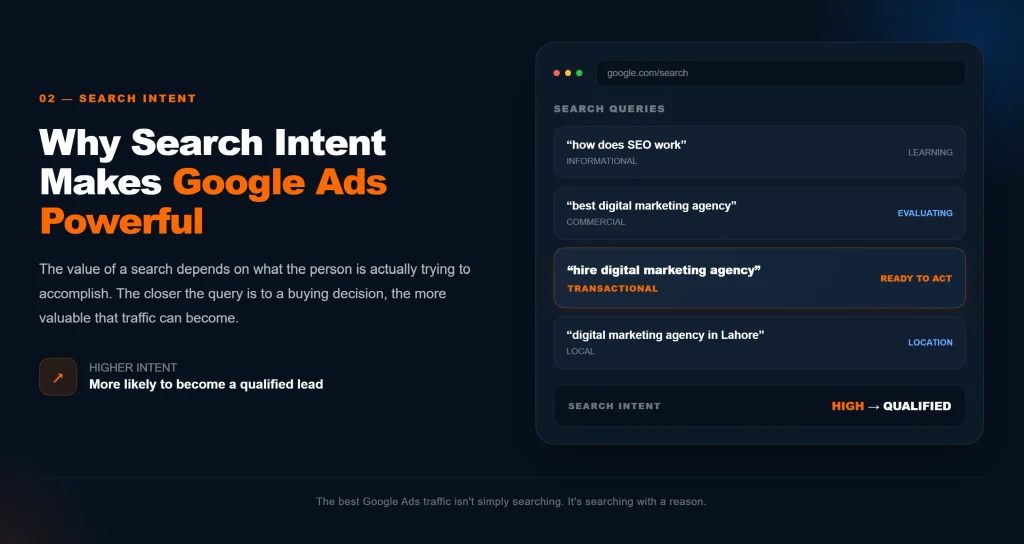
One of the biggest advantages of search advertising is that customers often tell you what they need through their searches.
Compare these searches:
- “how does solar energy work”
- “solar panel price”
- “solar installation company near me”
- “best solar company in Lahore”
They may all relate to solar energy, but they don’t represent the same level of commercial intent.
The first search is primarily informational.
The later searches can indicate that someone is comparing prices, providers, or solutions.
That distinction matters because advertising to every possible search can quickly consume a budget without producing enough business.
Different searches can represent different stages
Informational intent
The person is learning or researching.
Commercial investigation
The person is comparing products, services, or providers.
Transactional intent
The person is looking to purchase, book, contact, or take another action.
Local intent
The person is looking for a nearby business or service provider.
A strong campaign identifies these differences instead of treating every search as equally valuable.
The goal isn’t to buy as much traffic as possible.
It’s to capture the traffic that has the greatest potential to become a customer.
3. Choose Keywords Based on Business Intent
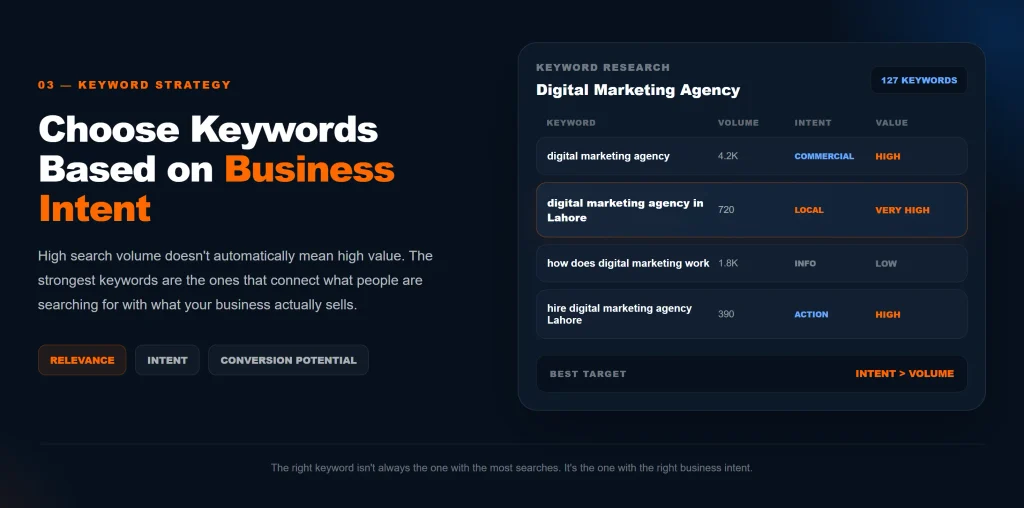
Keywords determine which searches your advertisements can potentially reach.
One of the most common mistakes businesses make is choosing keywords simply because they have high search volume.
High search volume does not automatically mean high business value.
A keyword receiving thousands of searches may generate very little revenue if most searchers have no intention of purchasing the service.
Instead, businesses should consider:
- Relevance to the actual service
- Commercial intent
- Search behavior
- Competition
- Expected conversion potential
- Geographic relevance
- Cost per click
- The landing page available for the keyword
For example, a company offering professional web development may want to distinguish between searches such as:
“what is web development”
and
“web development company Lahore.”
The first may be useful for educational content and SEO.
The second may represent a much stronger advertising opportunity.
Keyword research should therefore begin with the business’s actual customers and services, not just a keyword tool.
4. Understand Keyword Match Types and Search Relevance
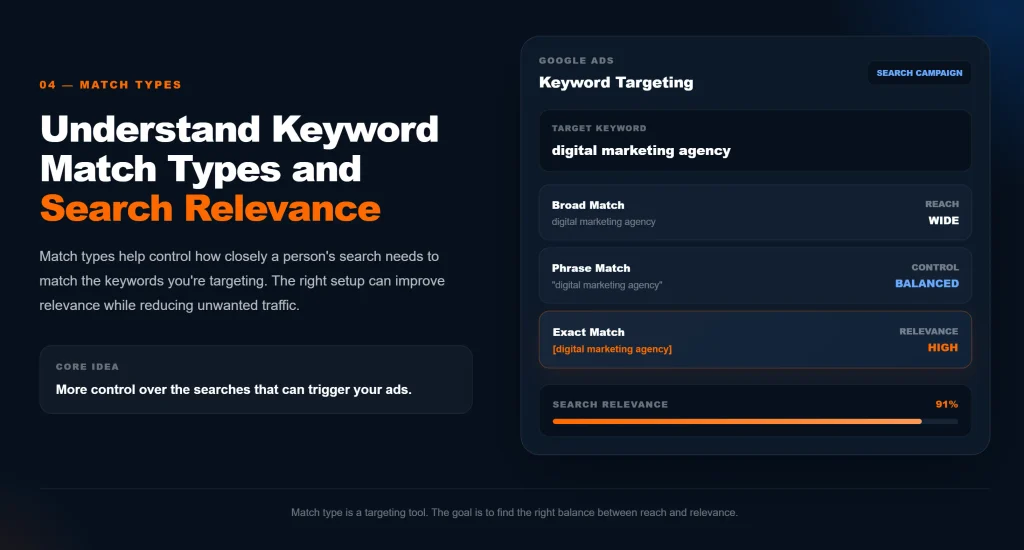
Google Ads provides different ways to control how closely a search needs to relate to a targeted keyword.
Broad matching can provide wider reach, while more controlled matching can help advertisers maintain greater relevance.
The right approach depends on the campaign, industry, budget, and amount of conversion data available.
The important principle is simple:
More traffic isn’t automatically better traffic.
A campaign generating 1,000 clicks from loosely related searches may perform worse than a campaign generating 300 clicks from highly relevant searches.
Advertisers should regularly review the searches that actually triggered their advertisements.
This can reveal:
- Irrelevant searches
- Unexpected customer needs
- New keyword opportunities
- High-performing search themes
- Terms that should be excluded
That information can then be used to improve targeting over time.
5. Negative Keywords Can Protect Your Budget
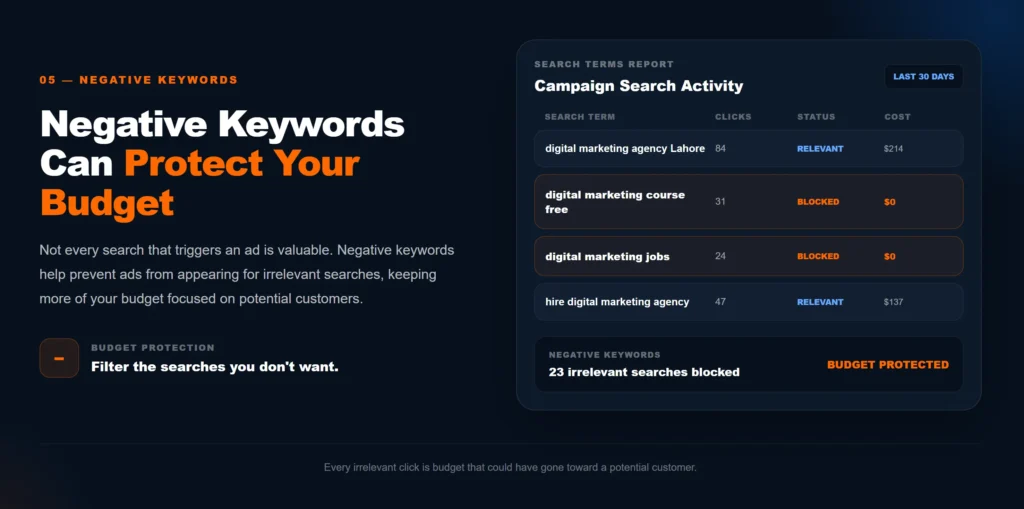
Not every search containing a target keyword is valuable.
A business selling premium commercial services could potentially appear for searches looking for:
- Free services
- Jobs
- Courses
- Tutorials
- DIY solutions
- Cheap alternatives
- Unrelated products
Those clicks may still cost money even though the searcher was never a realistic customer.
Negative keywords help advertisers prevent advertisements from showing for searches that are unlikely to produce useful results.
For example, a company selling a professional service may want to exclude searches containing terms such as “free,” “jobs,” or “course” when those searches have no commercial value for the business.
Negative keyword management shouldn’t be treated as a one-time task.
As a campaign collects more search data, advertisers can continue identifying irrelevant queries and adding appropriate exclusions.
Better filtering can mean more of the advertising budget goes toward genuine opportunities.
6. Write Advertisements That Match the Search
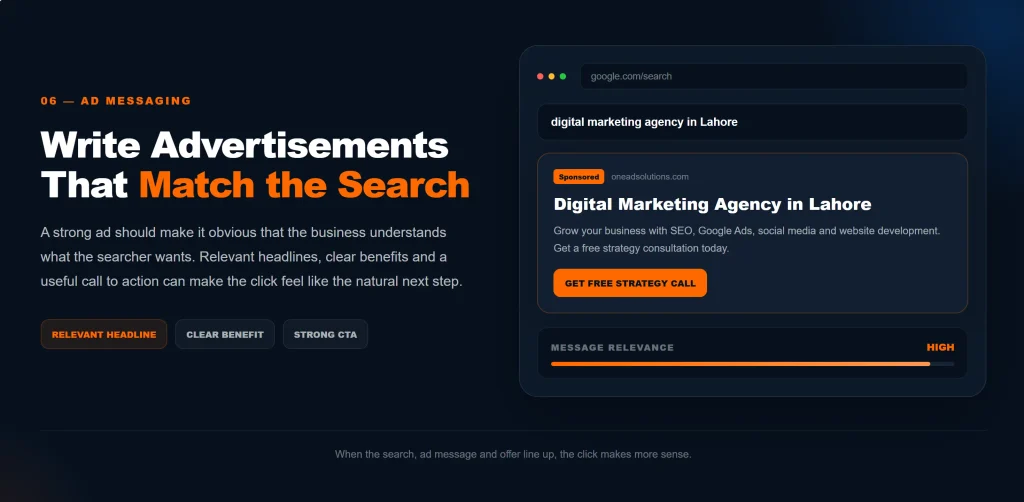
A potential customer should be able to understand the relevance of an advertisement almost immediately.
If someone searches for a specific service, a generic advertisement isn’t necessarily enough.
The advertisement should communicate:
- What the business offers
- Why the offer is relevant
- What differentiates the business
- What action the customer should take
The messaging should also connect naturally with the landing page.
Imagine someone searches for “Google Ads management services.”
If the advertisement talks about Google Ads management but sends the visitor to a generic homepage containing dozens of unrelated services, the experience becomes less focused.
A more relevant landing page can continue the same conversation.
This creates a simple but important chain:
Search → Message → Landing Page → Action
When each step matches the previous one, the customer doesn’t have to figure out whether they reached the right place.
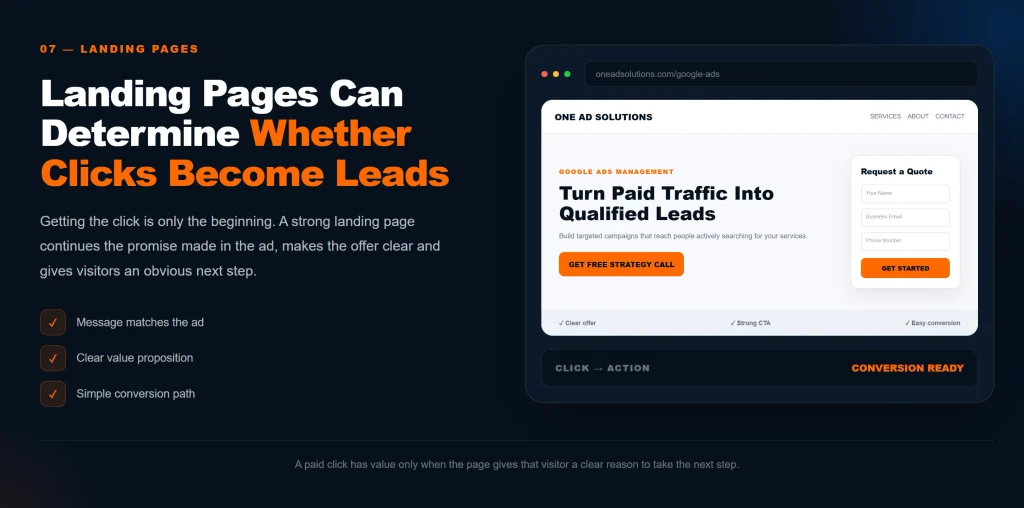
7. Landing Pages Can Determine Whether Clicks Become Leads
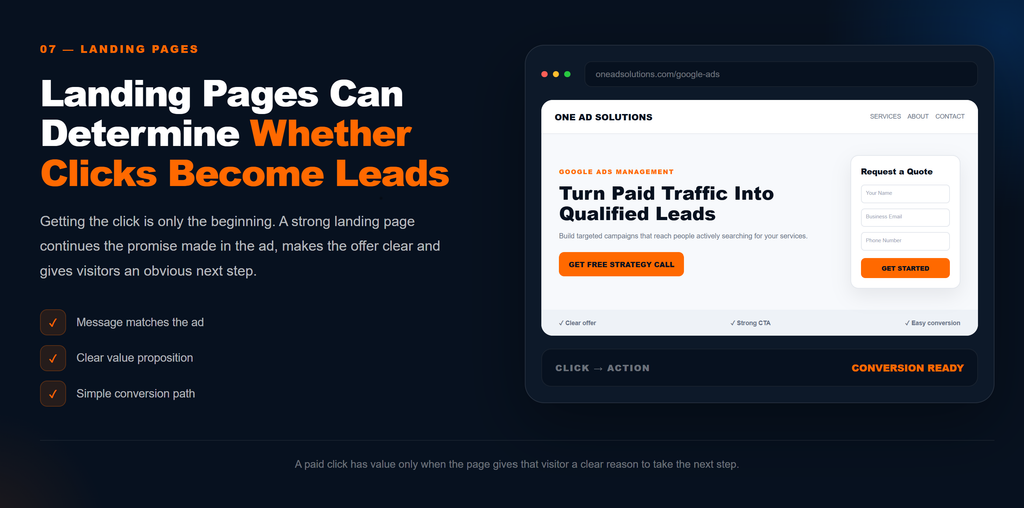
Getting someone to click an advertisement is only the beginning.
Once the visitor reaches the website, the landing page has to do its job.
A strong landing page should make the next step obvious.
Depending on the business, that might mean:
- Requesting a quote
- Booking a consultation
- Calling the business
- Filling out a form
- Purchasing a product
- Starting a conversation
Common landing-page problems include:
- Slow loading
- Weak headlines
- Unclear offers
- Too many distractions
- Poor mobile usability
- Missing trust signals
- Complicated forms
- No obvious call to action
The landing page should answer the visitor’s most important questions without making them work unnecessarily hard to find the information.
A successful Google Ads campaign doesn’t end when someone clicks.
It ends when the visitor takes a valuable action.
8. Target the Right Locations and Audiences
A business doesn’t necessarily need to advertise everywhere.
A local service company in Lahore may have little reason to spend most of its budget targeting people who cannot realistically become customers.
Location targeting can help businesses focus their advertising on the areas they actually serve.
Depending on the campaign, advertisers may consider:
- Cities
- Regions
- Service areas
- Customer locations
- Language
- Device behavior
- Audience signals
- Existing customer segments
For local businesses, this becomes particularly important.
A campaign targeting “digital marketing agency” across an entire country can behave very differently from one specifically designed around customers searching for a provider in Lahore.
The right targeting depends on the business model.
Advertising should follow the company’s actual market—not an arbitrary geographic radius.
9. Conversion Tracking Shows What the Campaign Is Actually Producing
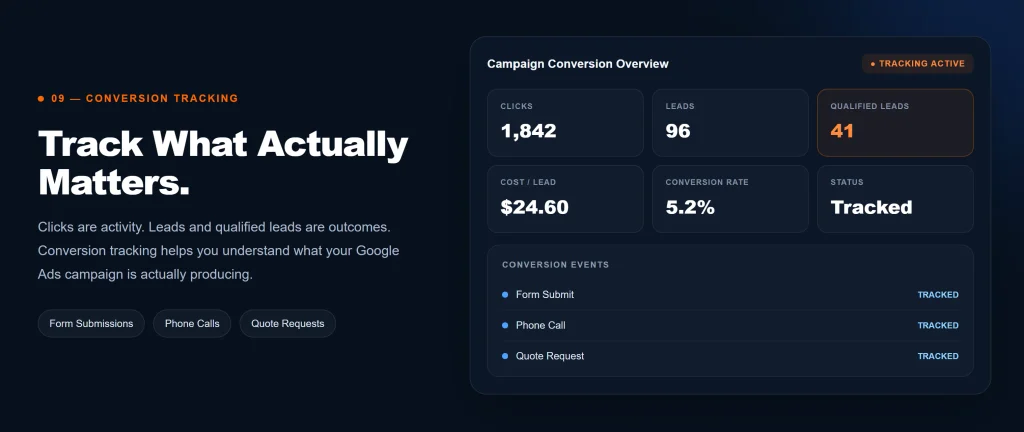
Clicks and impressions are useful metrics, but they don’t necessarily tell a business whether its advertising is producing revenue.
A campaign can have:
- Thousands of impressions
- Hundreds of clicks
- A strong click-through rate
and still generate very few meaningful leads.
That is why conversion tracking is essential.
Businesses should identify which actions actually matter.
Depending on the business, conversions might include:
- Contact form submissions
- Phone calls
- Purchases
- Quote requests
- Appointment bookings
- Sign-ups
- Qualified enquiries
Once these actions are tracked, advertisers can evaluate campaigns based on outcomes rather than vanity metrics.
The question changes from:
“How many clicks did we receive?”
to:
“How many valuable actions did those clicks produce?”
That is a much more useful question for determining advertising performance.
10. Google Ads Budgeting Is About More Than Setting a Daily Limit
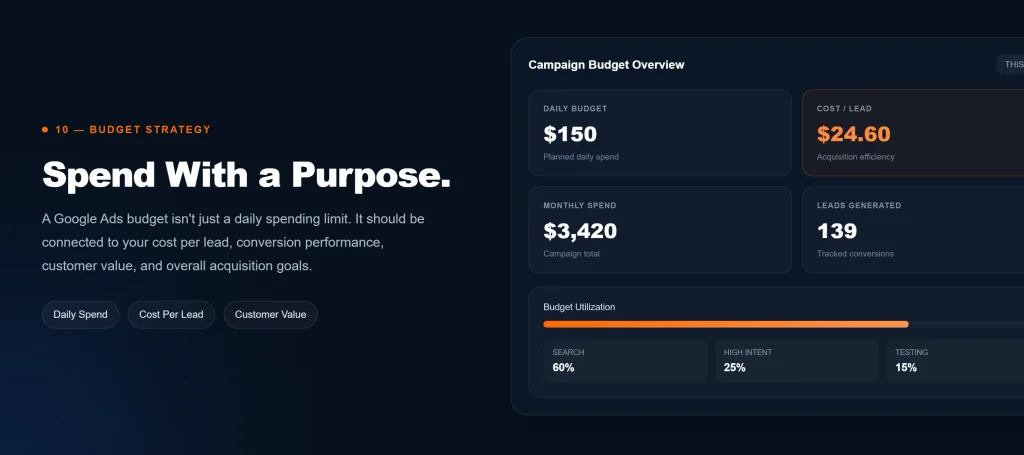
Every campaign has a budget, but simply deciding how much money to spend doesn’t create a strategy.
Businesses should understand what they are trying to achieve with that budget.
For lead generation, important questions include:
- How much is an average customer worth?
- What percentage of leads become customers?
- What is an acceptable cost per lead?
- Which services generate the highest-value enquiries?
- Which campaigns produce qualified leads?
- How much demand actually exists?
For example, a campaign generating inexpensive leads isn’t necessarily better than one generating more expensive leads if the second campaign produces significantly more valuable customers.
This is why advertising performance should eventually be evaluated against business economics, not just advertising metrics.
The objective isn’t to find the cheapest click.
It’s to find a sustainable path from advertising spend to profitable customer acquisition.
11. Campaign Optimization Should Be Continuous
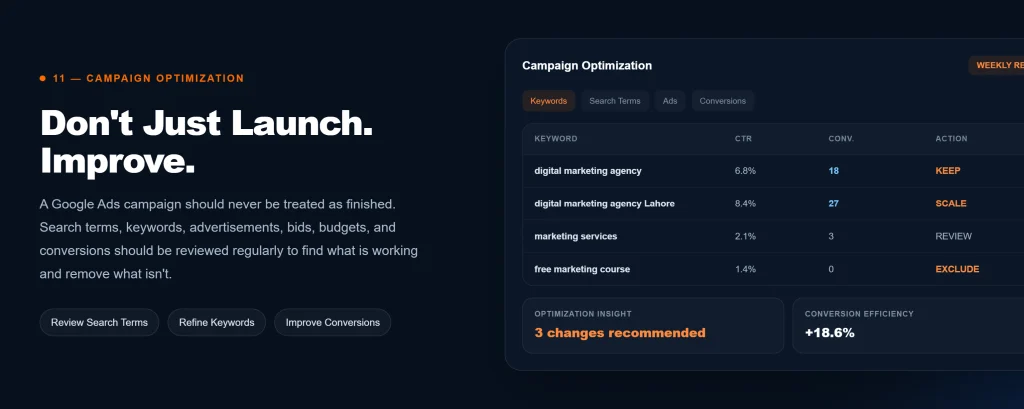
Launching a campaign is not the end of the process.
Search behavior changes.
Competition changes.
Costs change.
Customer demand changes.
And the campaign itself produces new information.
That means advertisers should regularly evaluate:
- Search terms
- Keywords
- Negative keywords
- Ad performance
- Landing pages
- Conversion rates
- Geographic performance
- Devices
- Budget allocation
- Cost per conversion
Underperforming areas can be adjusted while stronger opportunities receive more attention.
This is where professional campaign management can provide value.
Instead of launching advertisements and leaving them untouched, ongoing management uses performance data to continuously improve the campaign.
→ Explore our Google Ads Management Services.
12. Google Ads Works Best as Part of a Larger Digital Marketing Strategy
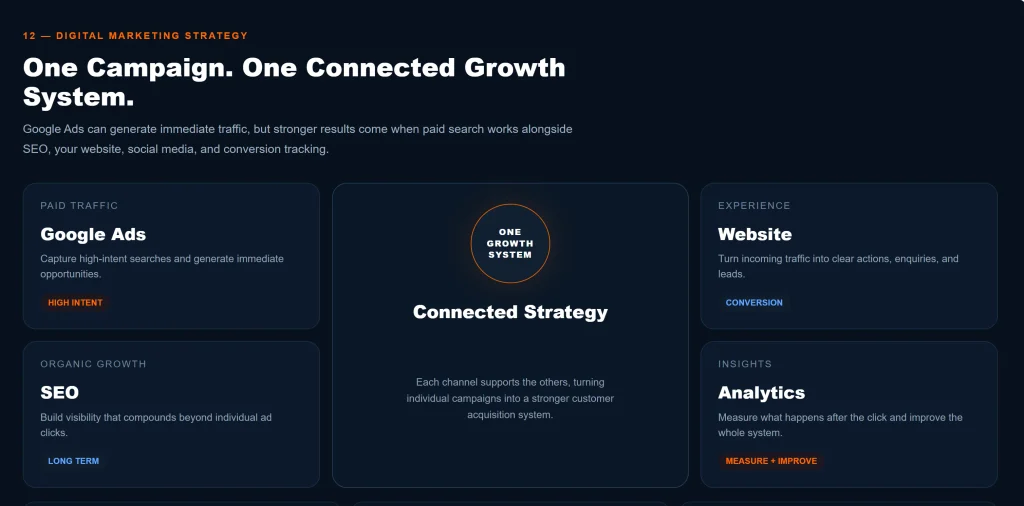
Google Ads can capture people who are ready to act, but it doesn’t have to work alone.
A business may use SEO to build long-term organic visibility while using Google Ads to capture immediate search demand.
Local SEO can help nearby customers discover the business through local search.
A strong website can turn paid and organic traffic into enquiries.
Social media can keep the brand visible between searches.
Video and graphic design can create stronger advertising and social content.
And analytics can help connect these activities to measurable business outcomes.
This is why Google Ads should be viewed as one part of a connected marketing system.
Our broader Digital Marketing Guide explains how these channels can work together rather than operating as isolated campaigns.
The complete customer journey
A well-structured campaign can follow a simple path:
Search → Ad → Landing Page → Conversion → Customer
But the wider marketing system can go even further:
SEO + Google Ads + Local SEO + Website + Social Media + Creative + Analytics
Each channel can support another.
That creates more opportunities for a potential customer to discover the business, understand its value, build trust, and eventually take action.
The Goal Isn’t More Clicks. It’s Better Customers.
Google Ads gives businesses access to something extremely valuable: existing search demand.
But access to that demand isn’t enough.
A profitable campaign requires the right combination of:
- Relevant search intent
- Focused keyword targeting
- Negative keyword management
- Relevant advertisements
- Strong landing pages
- Appropriate location targeting
- Accurate conversion tracking
- Effective budget allocation
- Continuous optimization
When these pieces work together, paid search becomes more than a source of website traffic.
It becomes a customer acquisition channel.
That is the real difference between simply running Google Ads and building a Google Ads strategy.
At One Ad Solutions, we help businesses approach paid advertising as part of a broader digital growth system—connecting search demand, advertising, websites, creative, and measurable conversions.