
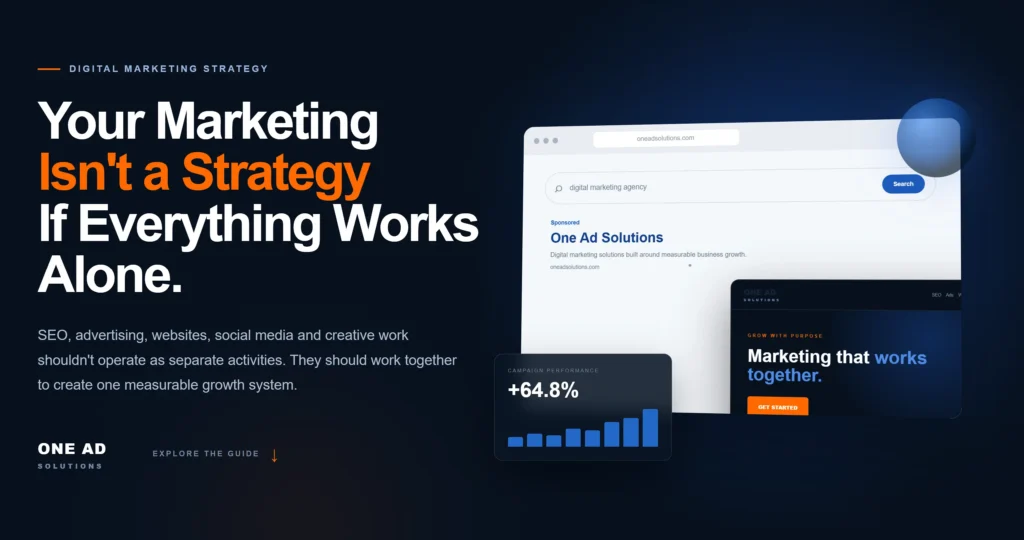
Putting up a website, posting occasionally on social media, and boosting a few random posts isn’t a digital marketing strategy.
A real digital marketing strategy starts with a clear business goal and connects the channels that can help achieve it. SEO can build long-term search visibility, Google Ads can capture people who are already looking for a solution, a high-converting website can turn that traffic into customers, and strong creative can make the brand easier to recognize and remember.
The important part is how these channels work together.
Someone might first discover a business through social media, later search for its services on Google, visit the website through an organic result or advertisement, and eventually become a customer. If every part of that journey is handled separately, opportunities can be lost between channels. When the channels support one another, each part of the marketing system has a clearer purpose.
At One Ad Solutions, we look at digital marketing as a connected growth system—not a list of unrelated services. As a digital marketing agency in Lahore, we help businesses choose and connect the channels that support their goals, from generating visibility and traffic to turning that traffic into measurable results.
This guide breaks down the major parts of digital marketing, what each channel is designed to accomplish, and how they can work together to create a more effective growth strategy.
1. SEO: Build Search Visibility That Compounds
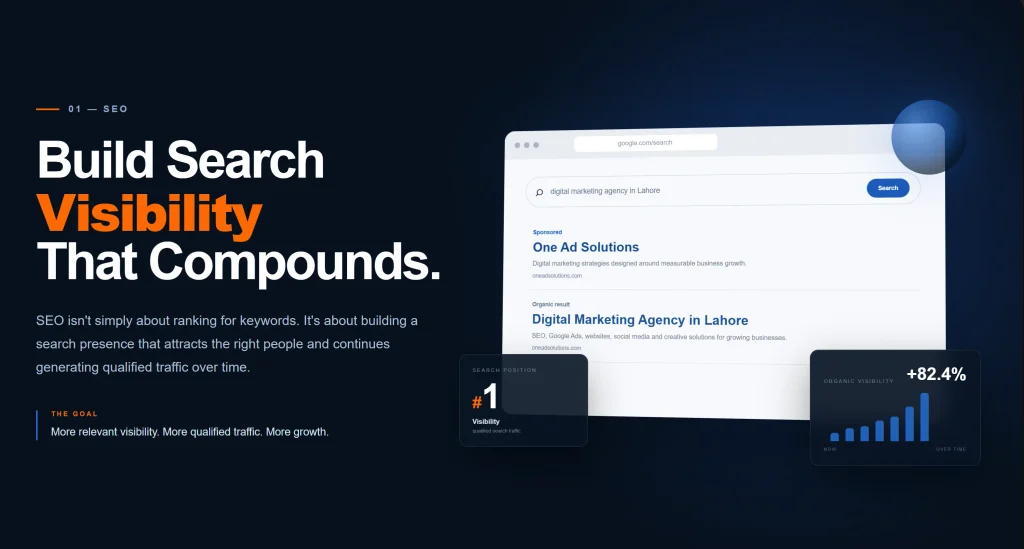
Search engines are often where customers begin their buying journey. They search for products, compare services, research companies, and look for solutions to specific problems.
The challenge is getting your business in front of them at the right moment.
Modern SEO for businesses is much more than placing keywords on a page. A strong search strategy needs to consider the entire website, the intent behind the searches you’re targeting, and the experience users have after they arrive.
What a strong SEO strategy focuses on
- Technical SEO: Making sure search engines can crawl, understand, and index your website properly.
- Search intent: Creating pages that satisfy what people are actually looking for.
- Content strategy: Publishing useful resources around the topics your potential customers care about.
- Internal linking: Connecting related pages so users and search engines can discover important content.
- Site structure: Organizing your website so your most valuable pages are easy to understand and reach.
- Ongoing optimization: Using performance data to identify opportunities and improve existing pages.
The goal isn’t to collect rankings just for the sake of rankings.
The goal is to attract relevant people who have a genuine reason to become customers.
SEO works better when other channels support it
SEO doesn’t have to operate on its own.
A useful article can attract someone through organic search, while social media can help distribute that content to a wider audience. Google Ads can capture searches while organic rankings are still developing. A well-designed website can then turn visitors from both paid and organic channels into leads or customers.
This is where SEO becomes part of a larger digital marketing strategy rather than an isolated traffic source.
The same research can also inform other channels. Search queries can reveal what customers care about, content can answer questions that appear throughout the buying journey, and high-performing organic pages can provide insights for paid campaigns and website improvements.
SEO Is Evolving
Search is also evolving beyond traditional blue links. AI-powered search experiences are changing how people discover information and businesses.
That makes the quality and structure of your content increasingly important. Pages need to be clear, useful, well-organized, and genuinely valuable—not simply written to satisfy a keyword.
For a deeper look at keyword research, search intent, technical SEO, content strategy, internal linking, and other fundamentals, read our complete SEO for businesses guide.
A strong SEO strategy builds an asset that can continue generating visibility and qualified traffic over time.
→ Explore our SEO Services.
2. Google Ads: Capture Customers Who Are Ready to Act
SEO builds long-term visibility, but businesses don’t always have the luxury of waiting for organic traffic to grow.
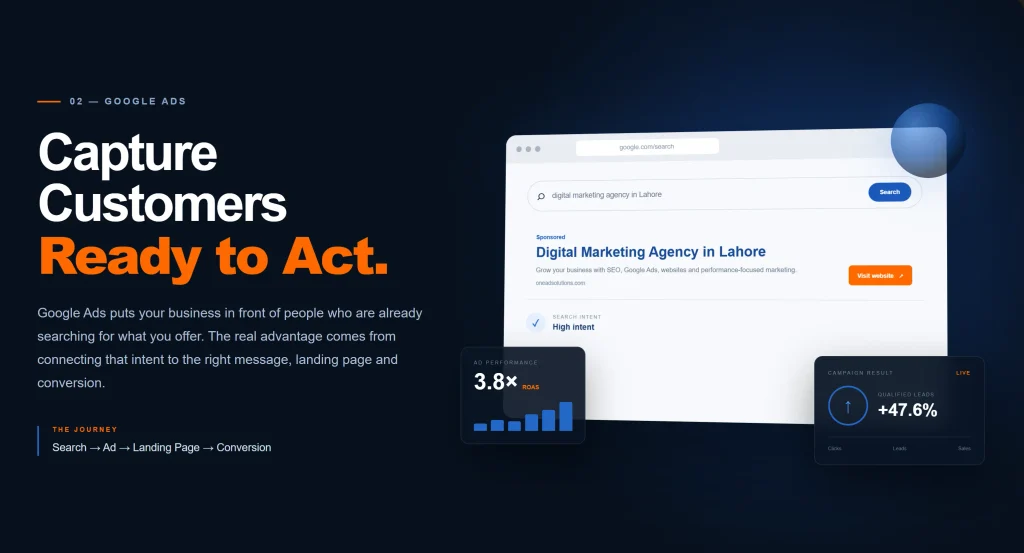
Google Ads allows businesses to put their offers in front of people who are already searching for relevant products and services. This makes paid search especially useful when a business wants to capture existing demand while its organic visibility is still developing.
Consider the difference between these two people:
- Someone casually watching a video about home renovations.
- Someone searching for “home renovation company near me.”
The second person has already demonstrated a stronger level of intent.
That’s where paid search becomes powerful.
Why Google Ads campaigns often waste money
Running advertisements isn’t difficult.
Running profitable advertisements is.
Businesses can waste their budget by:
- Targeting keywords with little commercial intent
- Using overly broad targeting
- Sending traffic to irrelevant pages
- Writing generic advertisements
- Ignoring negative keywords
- Failing to track conversions
- Keeping poor-performing campaigns running without optimization
A strong campaign connects the entire customer journey:
Search → Ad → Landing Page → Conversion
Every part needs to make sense.
If someone searches for a specific service, the advertisement should address that need, and the landing page should continue the same conversation. When those elements are disconnected, businesses can pay for clicks without getting meaningful results.
Google Ads works best as part of a larger strategy
Paid search can also support other parts of digital marketing.
Google Ads can generate immediate visibility while SEO works toward stronger organic rankings. Search and conversion data can reveal which services, offers, and keywords are generating real demand. That information can then help improve landing pages, website content, SEO priorities, and other marketing campaigns.
The goal isn’t to treat paid advertising as a separate activity.
It’s to use it as another entry point into the same digital marketing system.
The objective isn’t simply to generate clicks.
It’s to generate qualified leads and sales.
For a deeper look at keyword targeting, search intent, landing pages, conversion tracking, budgeting, and campaign optimization, read our Complete Google Ads guide.
→ Explore our Google Ads Services.
3. Local SEO: Own Your Local Market
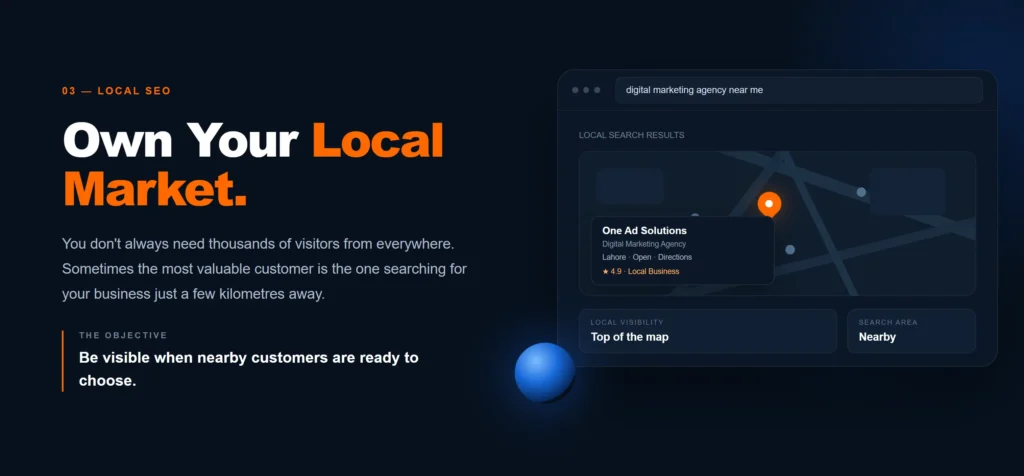
A business doesn’t always need thousands of visitors from around the world.
Sometimes it needs customers from five or ten kilometers away.
A restaurant needs nearby diners. A dentist needs nearby patients. A real estate company needs buyers and sellers in its market.
That’s where local search visibility becomes extremely valuable.
When customers search for businesses and services nearby, Google can display relevant businesses through Maps and local search results. Appearing prominently in those results can put a business in front of people who are already looking for a solution in its service area.
What a strong local SEO strategy focuses on
A strong local SEO strategy can include:
- Google Business Profile optimization
- Accurate business information
- Location-focused website content
- Relevant local citations
- Genuine customer reviews
- Service-area pages
- Local keyword targeting
- Consistent business information across platforms
These elements help establish clear connections between the business, its services, and the locations it serves.
The objective isn’t to simply say that you’re located somewhere.
It’s to establish strong relevance between your business, your services, and the locations you serve.
Local SEO works with the rest of your marketing
Local SEO becomes even more valuable when it is connected to the rest of the digital marketing strategy.
A well-optimized Google Business Profile can help customers discover a business in local search, while location-focused website pages can provide more information and support organic rankings. Reviews can strengthen trust, and paid advertising can help capture additional local demand.
The same website, content, reviews, and business information can therefore support multiple customer touchpoints instead of functioning as isolated marketing activities.
For a business competing in a specific city or region, local SEO can become one of its most valuable sources of qualified traffic and local customers.
For a deeper look at how local search works and how businesses can improve their visibility, read our Local SEO Guide
→ Explore our Local SEO Services.
4. Website Development: Turn Traffic Into Customers
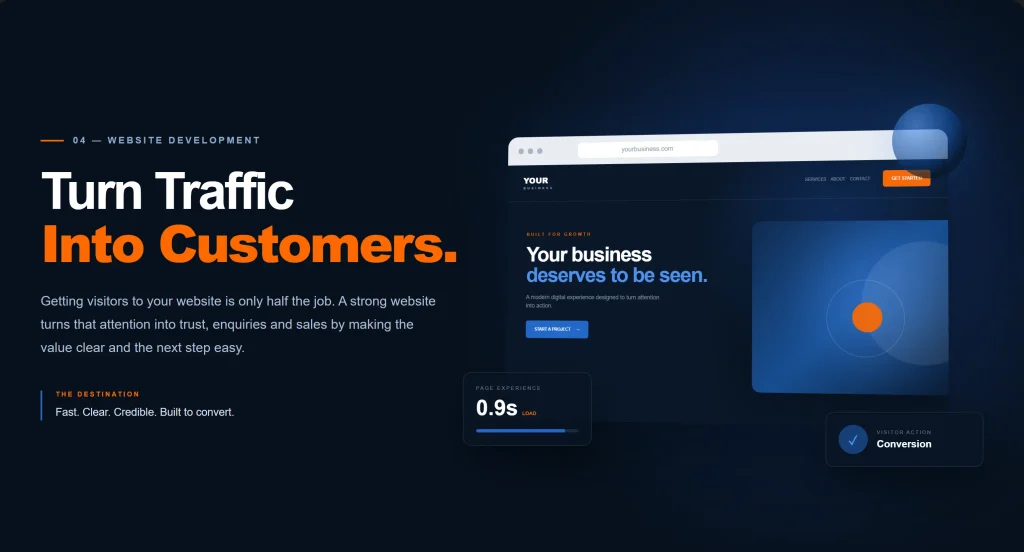
Here’s a problem many businesses overlook.
They spend money getting people to their website, but the website itself isn’t designed to convert them.
A visitor might arrive through Google, an advertisement, social media, or another marketing channel and immediately encounter:
- Slow loading times
- Confusing navigation
- Weak messaging
- Poor mobile design
- No obvious call to action
- Too much unnecessary information
- An outdated visual appearance
At that point, getting more traffic won’t necessarily solve the problem.
You need a better destination.
Your website is often the point where a potential customer decides whether your business is credible enough to contact, make a purchase, or take the next step.
What a conversion-focused website should do
A strong website should:
- Load quickly and provide a smooth user experience
- Work well on mobile devices where a large portion of visitors may arrive
- Make the company’s value immediately clear
- Use intuitive navigation so visitors can find what they need
- Present services or products clearly
- Build trust through professional design and useful information
- Make the next step obvious
- Remove unnecessary friction from the conversion process
A website shouldn’t simply tell visitors that your company exists.
It should help move them toward becoming customers.
Your website connects your marketing channels
This is where website development becomes part of the larger digital marketing strategy.
SEO and Google Ads can bring qualified visitors to the website, while social media and content can introduce people to the brand. The website then needs to give those visitors a clear path toward contacting the business, requesting a quote, making a purchase, or taking another meaningful action.
For a deeper look at the planning, development process, performance, SEO foundations, costs, and common mistakes involved in building a business website, read our Complete guide to website development.
That means website performance, messaging, structure, and conversion paths should be considered alongside the marketing channels sending traffic to it.
There’s little value in generating thousands of visitors if the website isn’t prepared to turn that attention into business.
The goal isn’t simply to get people to your website. It’s to give them a reason to stay and take the next step.
→ Explore our Website Development Services.
5. Social Media Marketing: Turn Attention Into Familiarity
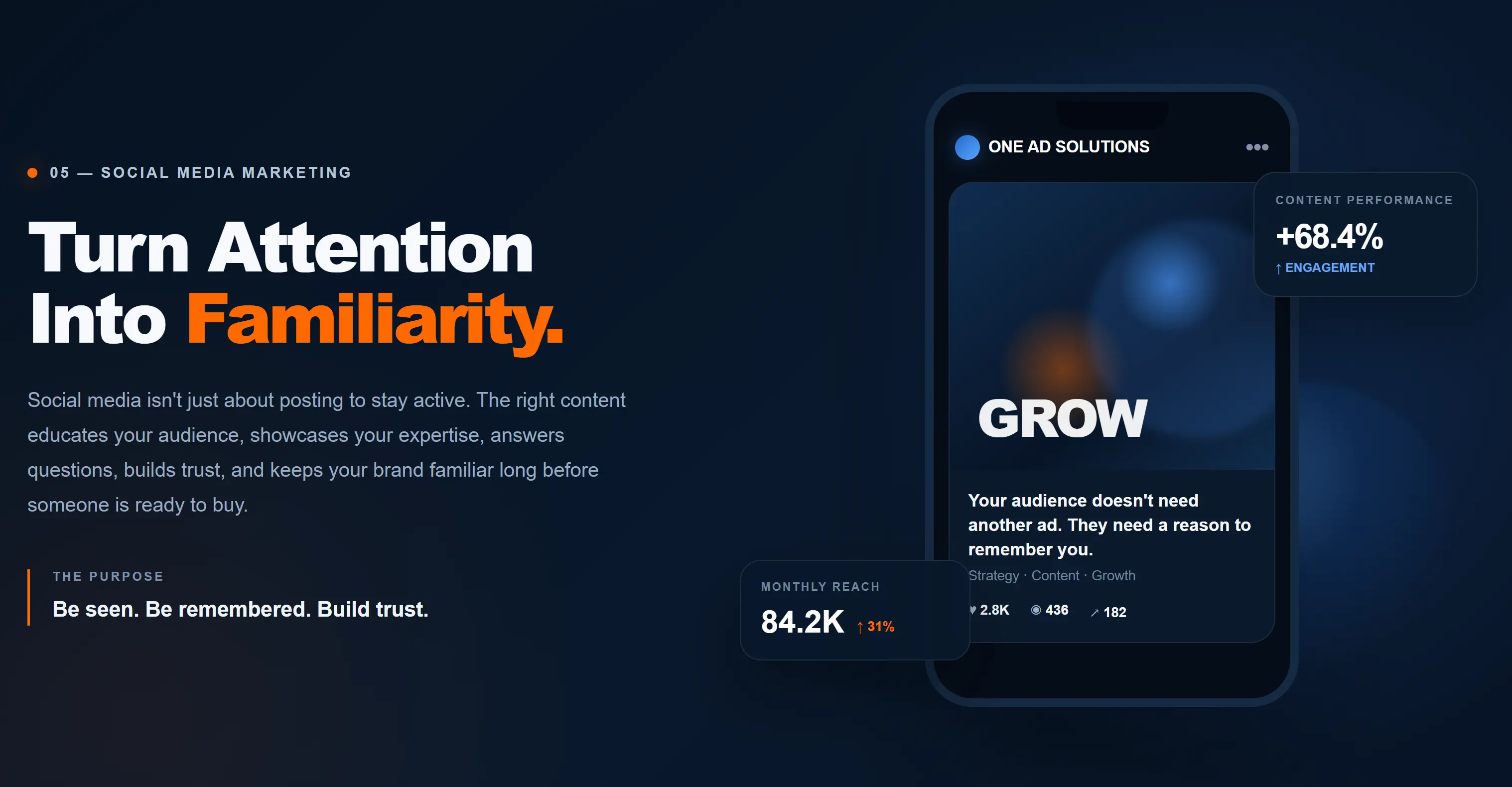
Not every potential customer is ready to buy the first time they discover your business.
Social media gives brands a way to stay visible while building familiarity, trust, and interest over time.
But successful social media marketing isn’t about posting just to keep a profile active.
Every piece of content should have a purpose.
What social media content should accomplish
- Educate your audience about problems and solutions.
- Showcase products and services.
- Demonstrate expertise.
- Answer common customer questions.
- Build trust through useful and authentic content.
- Generate conversations with potential customers.
- Support paid campaigns with stronger creative assets.
The goal isn’t to chase followers who will never become customers.
It’s to build an audience that has a genuine reason to care about what your business offers.
Social media works better when connected to other channels
Social media doesn’t have to be the final destination.
A useful post can introduce someone to your brand, while your website can give them more information about your services. Strong content can also support advertising campaigns, reinforce SEO content, and give potential customers another way to interact with your business.
This makes social media more valuable than simply maintaining an active profile.
It becomes another entry point into the wider digital marketing system, helping people discover your brand, become familiar with it, and eventually take the next step.
The goal isn’t simply more posts or more followers. It’s turning attention into familiarity, trust, and meaningful customer action.
→ Explore our Social Media Marketing Services.
6. Video Editing: Win Attention Before You Sell

The internet is crowded.
Your potential customer can scroll past your content in seconds.
That makes attention one of the most valuable resources in digital marketing.
Video gives businesses a powerful way to communicate ideas quickly, demonstrate products, explain services, and tell stories.
But simply putting footage together isn’t enough.
Effective marketing videos need:
- A strong opening hook
- Clear messaging
- Good pacing
- Professional editing
- Visual consistency
- A clear purpose
- A relevant call to action
The strongest marketing videos are created with their intended audience and purpose in mind. A short social video may need to capture attention immediately, while a product video may need to demonstrate features clearly and a paid advertisement may need to move viewers toward a specific action.
Video can support multiple marketing channels
A well-produced video doesn’t have to be used only once.
The same core video can potentially be adapted for social media, advertisements, websites, product pages, landing pages, and other marketing campaigns.
This also allows video to support the wider digital marketing strategy. Social content can introduce the brand, paid campaigns can distribute the strongest creative to targeted audiences, and website pages can use video to explain products or services more effectively.
That makes good video content more than a creative asset.
It becomes reusable marketing infrastructure that can support multiple parts of the customer journey.
→ Explore our Video Editing Services.
7. Graphic Design: Make Your Brand Worth Remembering

People form impressions quickly.
Before someone reads your entire advertisement or studies your website, they’ve already seen your colors, typography, imagery, layout, and overall presentation.
Weak visuals can make a strong business look less credible.
Professional design helps create consistency across the different places where customers interact with a brand.
Graphic design can strengthen:
- Social media content
- Advertising campaigns
- Website visuals
- Promotional materials
- Brand identity
- Marketing campaigns
- Product presentations
The goal isn’t to make everything look flashy.
It’s to make your communication clear, recognizable, professional, and aligned with the brand you’re trying to build.
Design connects the customer experience
A consistent visual identity can make different marketing channels feel like parts of the same business.
The colors and visual language used in a social media post can carry into an advertisement. The same identity can continue across the website, promotional graphics, product presentations, and other customer touchpoints.
That consistency helps customers recognize the brand more easily and creates a more cohesive experience as they move between channels.
Good design supports the message.
It doesn’t compete with it.
→ Explore our Graphic Design Services.
8. Product Photography: Make Your Products Look as Good Online as They Do in Person
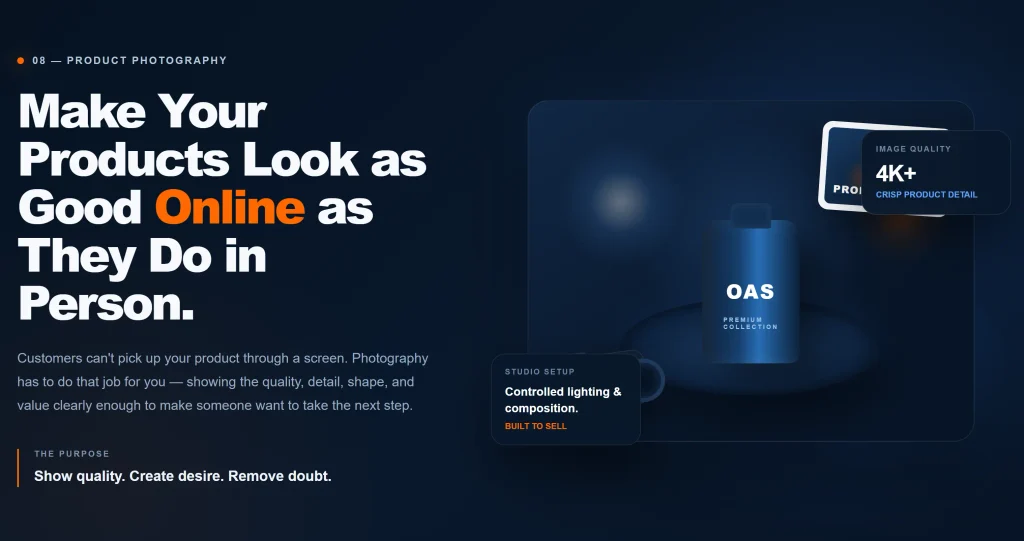
For e-commerce businesses, customers can’t physically hold a product before purchasing.
They judge it through images.
That makes product photography an important part of the buying experience.
Poor images can create uncertainty:
- What does the product actually look like?
- How large is it?
- What are its details?
- What does the packaging look like?
- Does it look trustworthy?
Professional product photography can answer those questions visually and give customers a clearer understanding of what they’re considering.
How strong product images help businesses
- Showcase important product details
- Present products consistently
- Build customer confidence
- Improve product pages
- Create better social media content
- Produce stronger advertising creatives
- Present products professionally across marketplaces
Product photography supports more than product pages
Good product photography can become a reusable creative asset across the wider marketing strategy.
The same images can support ecommerce product pages, social media content, paid advertisements, promotional campaigns, marketplaces, and other customer touchpoints.
This creates a more consistent presentation while giving businesses stronger visual material to use across different channels.
When customers understand what they’re buying, there’s less uncertainty between interest and purchase.
The goal isn’t simply to make a product look attractive. It’s to make the product easier to understand, trust, and choose.
→ Explore our Product Shoot Services.
The Real Advantage: Connecting Every Channel
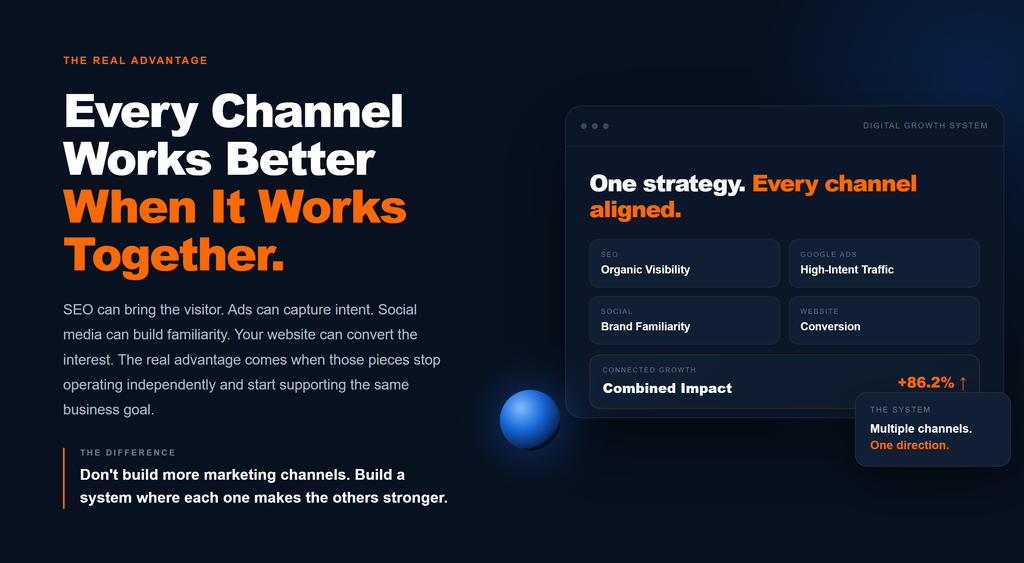
The biggest mistake businesses can make is treating every marketing channel as a separate project.
Imagine launching a new service.
Your website provides a dedicated page designed to explain the service and turn visitors into customers. At the same time, your SEO strategy builds organic visibility around searches related to that service.
A Google Ads campaign can capture people who are actively searching for the service right now, while Local SEO helps nearby customers discover the business when they are ready to take action.
On social media, consistent content keeps the service in front of your audience. A well-produced video can demonstrate what makes the service valuable, while graphic design keeps the campaign visually consistent across different platforms.
Each channel has a different job.
But they work better when they support one another.
One strategy, multiple entry points
A customer might discover the service through social media, search for it on Google later, visit the website through an organic result or advertisement, and then decide whether to contact the business.
The customer sees different parts of the same business at different stages of the journey.
That means the goal isn’t to run seven separate marketing activities.
It’s to build one connected system with multiple entry points.
When the channels are planned together, insights from one part of the strategy can improve another. Search data can influence content. Advertising data can reveal which offers attract customers. Website behavior can show where visitors are dropping off. Creative assets can then be adapted across campaigns and platforms.
The result is a marketing system where each channel has a purpose while contributing to the same business goal.
The real advantage isn’t doing more marketing. It’s making the marketing you already do work together.
Building the Right Digital Marketing Strategy
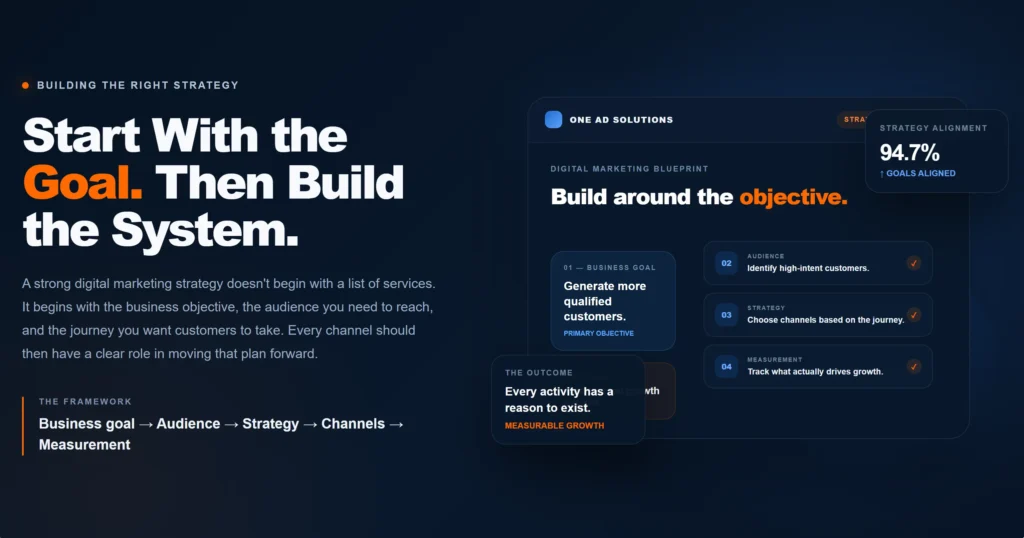
There’s no universal formula that every business should follow.
The right strategy depends on the business, its market, its customers, its goals, and its current position. A strategy that works for a local service business may be completely different from what an e-commerce company or a new startup needs.
Instead of choosing channels first, start with the business objective and work backward.
1. Define the business goal
The first step is understanding what the marketing strategy actually needs to accomplish.
Is the business trying to:
- Generate more qualified leads?
- Increase online sales?
- Reach customers in a specific location?
- Launch a new service or product?
- Build awareness for a new brand?
- Improve the number of visitors who become customers?
Different goals require different approaches.
A business focused on generating local leads may need a different channel mix from an e-commerce company trying to increase product sales.
2. Understand the customer
Before choosing marketing channels, understand who the business is trying to reach and how those people make decisions.
Ask:
- Who are we trying to reach?
- What problems are they trying to solve?
- What are they searching for?
- What questions do they ask before buying?
- Where do they discover businesses like ours?
- What factors influence their decision?
This helps identify where potential customers are most likely to interact with the business.
3. Choose the right acquisition channels
Once the audience and business goal are clear, choose the channels that can realistically reach those customers.
A local service business may prioritize Local SEO + Google Ads to capture people searching for services in its area.
An e-commerce company might benefit more from SEO + product photography + social media + paid advertising.
A new business may first need to establish its website, branding, content, and overall online presence before aggressively investing in traffic acquisition.
The goal isn’t to use every available channel.
It’s to use the channels that have a clear role in reaching the right customers.
4. Fix the conversion point
Generating traffic is only part of the process.
Once someone reaches the website, landing page, product page, or another conversion point, the business needs to give them a clear reason to take the next step.
That could mean:
- Requesting a quote
- Calling the business
- Booking an appointment
- Purchasing a product
- Filling out a lead form
- Starting a conversation
If visitors are arriving but not converting, simply increasing traffic may not solve the problem.
The website, offer, messaging, user experience, and conversion path may need attention first.
5. Connect the channels
The strongest strategies don’t treat each channel as an isolated campaign.
SEO can provide search and content insights. Google Ads can reveal which keywords and offers generate qualified leads. Social media can distribute content and build familiarity. The website can bring all of these visitors toward the same conversion goal.
The channels should support one another instead of competing for attention and budget.
6. Measure what actually matters
Traffic and impressions can show whether people are discovering the business, but they don’t tell the entire story.
Businesses should also measure outcomes such as:
- Qualified leads
- Sales
- Conversion rates
- Cost per lead
- Cost per acquisition
- Revenue generated
- Return on advertising spend
- Performance by channel
This makes it easier to identify which parts of the strategy are producing business results and which need improvement.
7. Optimize the strategy over time
A digital marketing strategy shouldn’t be considered finished after the initial campaigns are launched.
Search behavior changes. Competitors change. Advertising costs change. Websites can develop new problems. Some content performs better than expected while other campaigns may underperform.
Regular analysis allows businesses to adjust their strategy based on actual performance rather than assumptions.
The goal is not to constantly add more channels.
It’s to improve the system that is already in place.
The strategy should follow the business
A successful digital marketing strategy starts with the business—not with a list of services.
Understand the goal, identify the customer, choose the right acquisition channels, create a strong conversion point, connect the customer journey, measure the results, and improve based on the data.
The strategy should follow the business—not the other way around.
Digital Marketing Is No Longer About Doing More. It’s About Connecting Better.
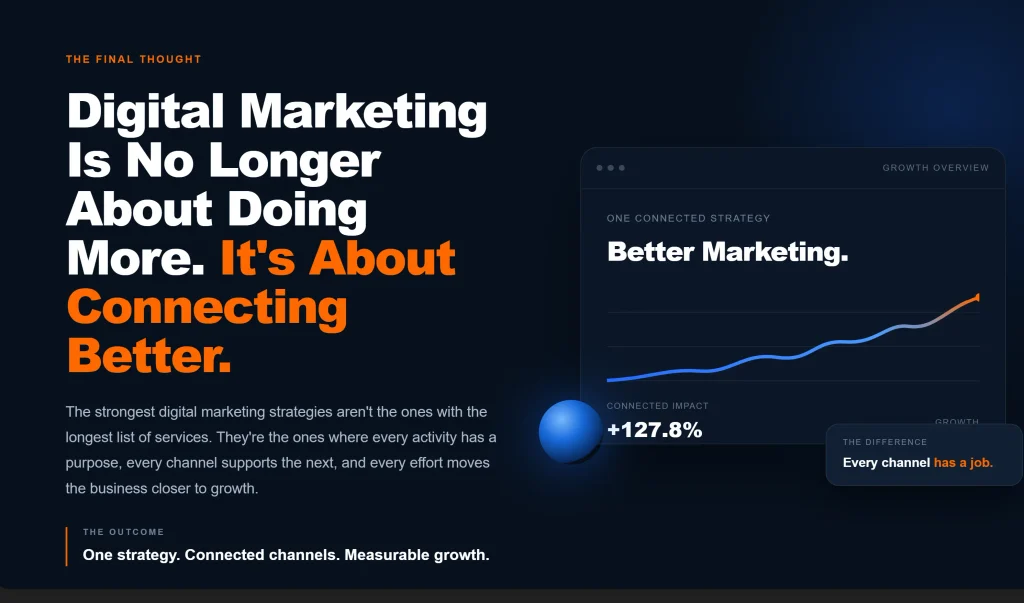
Businesses don’t need another collection of disconnected marketing activities.
They need a system where every part of their digital presence has a clear purpose and supports the same business objective.
A strong digital marketing system connects:
- Visibility — bringing the right potential customers to the business through search, advertising, social media, and other channels.
- Creative — earning attention, communicating value, and making the business easier to recognize and remember.
- Website — turning visitors into customers by providing clear information, building trust, and guiding people toward the next step.
- Offer — giving potential customers a clear reason to choose the business instead of simply presenting another product or service.
- Conversion — turning interest into meaningful actions such as leads, enquiries, bookings, or sales.
- Data — showing what is working, where customers are dropping out, and where the strategy needs improvement.
These elements shouldn’t operate independently.
SEO can bring someone to the website. A strong page can help them understand the offer. Good design can build credibility. A video can explain the value of the service. Google Ads can capture existing demand. Local SEO can help nearby customers discover the business. Conversion data can then show which parts of the journey are actually producing results.
That is what makes digital marketing a system rather than a collection of services.
The goal isn’t to be everywhere or to keep adding more campaigns.
The goal is to understand how customers discover a business, how they evaluate it, what makes them take action, and how each marketing channel can support that journey.
At One Ad Solutions, that’s the approach we believe digital marketing should take.
We focus on connecting the right channels around the right business goals, using strategy, creative, technology, and performance data to build a marketing system that can improve over time.
Not more noise. Not random campaigns.
A connected digital marketing strategy built around measurable business growth.
Frequently Asked Questions
Digital marketing is the use of online channels to promote a business, attract potential customers, and generate measurable results. It can include SEO, Google Ads, social media, websites, content, email marketing, video, and other digital channels.
The main types include SEO, Google Ads and other paid advertising, local SEO, social media marketing, content marketing, website optimization, video marketing, and email marketing. The right combination depends on the business, target audience, market, and goals.
There is no single channel that works for every business. A business should start with the channels that best match its customers, goals, market, and available resources, then connect those channels into a broader strategy.
SEO usually takes time because search visibility develops through improvements to a website’s technical foundation, content, authority, and relevance. The timeframe varies depending on competition, website condition, industry, and the strategy being implemented.
Neither is automatically better. Google Ads can provide immediate visibility for relevant searches, while SEO can build organic visibility over time. Many businesses can benefit from using both as part of a connected digital marketing strategy.
Local SEO helps businesses become more visible when people search for products or services in a specific area. Optimizing a Google Business Profile, website, location information, reviews, and local content can help attract customers who are searching nearby.
Digital marketing success should be measured against the business goal. Depending on the objective, useful metrics can include qualified leads, sales, conversion rate, cost per lead, customer acquisition cost, revenue, return on ad spend, and organic search performance.