

Graphic design is one of the most visible parts of a business’s marketing. Before someone reads your website copy, contacts your business, or learns about your services, they may already have formed an impression from your logo, social media posts, advertisements, website graphics, or promotional materials.
Good graphic design helps a business communicate clearly and maintain a consistent visual identity across different platforms. It can make information easier to understand, help important messages stand out, and give customers a consistent experience whenever they see the brand.
For businesses using digital marketing, graphic design is not separate from marketing. It supports social media, advertising, websites, content, presentations, promotional campaigns, and other parts of the customer journey.
In this guide, we will look at what graphic design is, why it matters for businesses, the different types of graphic design, how it supports digital marketing, common mistakes to avoid, the design process, and what to consider when working with a professional designer.
What Is Graphic Design?
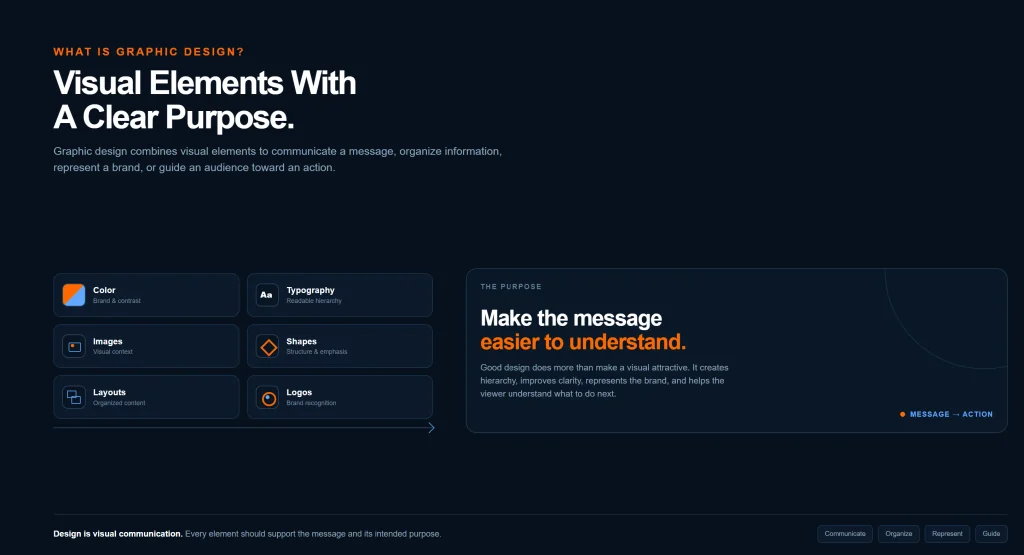
Graphic design is the process of using visual elements to communicate a message or idea.
These elements can include:
- Colors
- Typography
- Images
- Icons
- Shapes
- Illustrations
- Layouts
- Logos
- Patterns
- Visual effects
A graphic designer combines these elements to create a visual that has a specific purpose.
For example, a social media post may be designed to promote a service. A brochure may explain a company’s offerings. An advertisement may encourage someone to visit a website. A business card may provide contact information while representing the company’s visual identity.
The purpose is not simply to make something look attractive.
Good graphic design helps people understand what they are looking at and what they should do next.
That is why design is closely connected to communication and marketing.
Why Does Graphic Design Matter for Businesses?
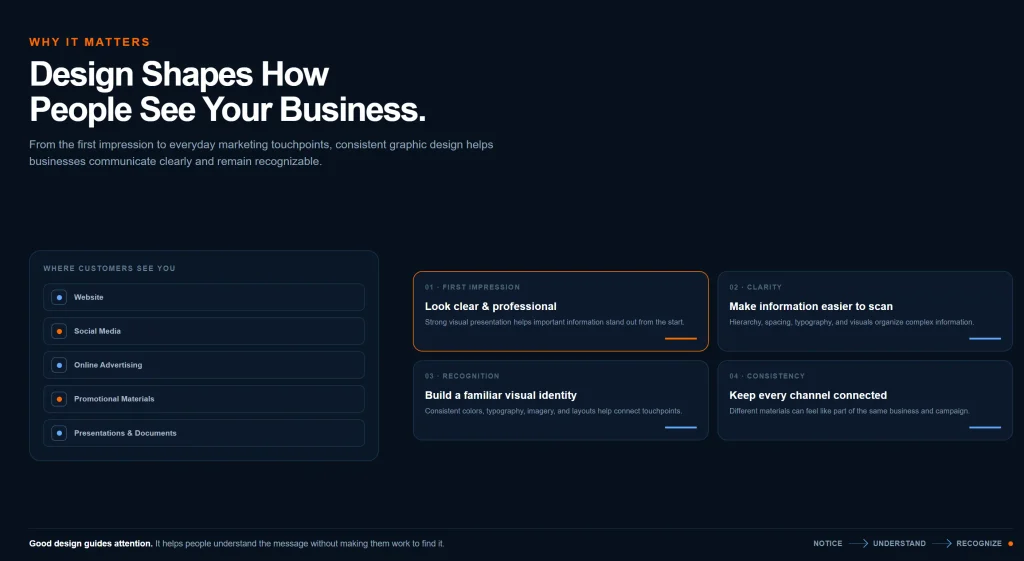
Businesses communicate with customers through many visual touchpoints.
A customer might encounter a company through:
- A Google search
- A website
- Instagram or Facebook
- An online advertisement
- A promotional banner
- A business card
- A presentation
- A product image
- A brochure
- An email
- A printed advertisement
If every one of these uses completely different colors, fonts, layouts, and visual styles, the business can feel inconsistent.
A consistent design system makes it easier for people to recognize the brand across different platforms.
Graphic Design Helps Create a First Impression
Your visual presentation is often one of the first things people notice.
A poorly arranged graphic can make important information difficult to find. A clear design can guide the viewer toward the main message.
For example, a promotional graphic may need to communicate three things quickly:
What is being offered?
Why does it matter?
What should the customer do next?
Good design organizes these elements so the viewer does not have to search for the information.
Graphic Design Makes Information Easier to Understand
Design can also simplify complicated information.
Instead of presenting a large block of text, a designer can use headings, icons, spacing, visual hierarchy, and supporting graphics to make the information easier to follow.
This is especially useful for:
- Infographics
- Presentations
- Service explanations
- Educational content
- Reports
- Product information
- Social media content
Graphic Design Builds Visual Consistency
A business should not need to reinvent its visual identity every time it creates a new post or advertisement.
Using consistent colors, typography, imagery, spacing, and design patterns creates a recognizable visual system.
This is particularly important when a business is active on several marketing channels.
Types of Graphic Design
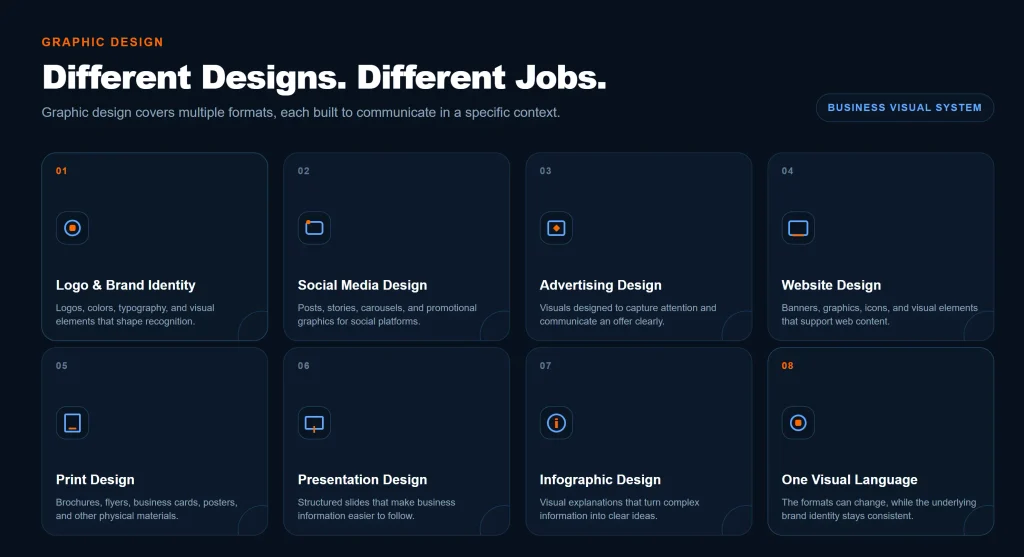
Graphic design covers many different areas. The exact type of design a business needs depends on its goals, audience, industry, and marketing channels.
1. Logo and Brand Identity Design
A logo is only one part of a brand identity.
A complete visual identity can include:
- Logo variations
- Brand colors
- Typography
- Icons
- Patterns
- Image styles
- Graphic elements
- Brand guidelines
The goal is to create a consistent visual language that can be used across different materials.
For example, a company may use the same primary colors and typography on its website, social media posts, brochures, advertisements, and business documents.
This makes the different materials feel like they belong to the same business.
2. Social Media Graphic Design
Social media platforms are highly visual.
Businesses regularly need graphics for:
- Instagram posts
- Instagram stories
- Facebook posts
- Promotional announcements
- Educational posts
- Product promotions
- Service promotions
- Event announcements
- Carousels
- Cover graphics
Social media graphics also need to follow platform-specific dimensions.
A design created for an Instagram post may not work correctly as a story or Facebook cover.
Professional design considers both the visual appearance and the platform where the content will be published.
3. Advertising Design
Digital advertising often gives users only a short amount of time to notice an advertisement.
The design needs to make the main message clear.
An advertising graphic may include:
- A headline
- Product or service image
- Offer
- Supporting information
- Brand logo
- Call to action
The most important information should have enough visual emphasis to be noticed first.
For example, an advertisement promoting a website development service should not make the viewer search through the design to find the actual service being offered.
The design should support the advertising objective rather than compete with it.
Advertising designs also need to work within the requirements of the platform where they appear. A social media advertisement, website banner, display ad, and printed advertisement may all require different dimensions and layouts.
The main message should remain clear when the design is adapted to different formats. Changing the size or layout should not remove the most important information or make the call to action difficult to find.
The relationship between the design and the advertisement’s goal is also important. If the objective is to generate enquiries, purchases, sign-ups, or website visits, the design should make the next step easy to understand.
For example, an advertisement promoting a service might present the main benefit first, followed by a short supporting message and a clear call to action. The exact structure will depend on the campaign, audience, and platform.
4. Website Graphic Design
Websites use many visual elements beyond the basic page layout.
These can include:
- Website banners
- Hero graphics
- Icons
- Service illustrations
- Infographics
- Promotional sections
- Feature graphics
- Background graphics
- Custom visual elements
Website graphics should support the content instead of making the page unnecessarily complicated.
They also need to work across different screen sizes.
A graphic that looks good on a large desktop monitor may become difficult to read on a mobile phone if it is not designed properly.
5. Print Graphic Design
Graphic design is not limited to digital marketing.
Businesses may also need designs for printed materials such as:
- Business cards
- Brochures
- Flyers
- Posters
- Menus
- Banners
- Packaging
- Certificates
- Company profiles
- Promotional materials
Print design has its own technical requirements.
For example, a file prepared for printing may need different dimensions, resolution, color settings, and bleed requirements compared with a graphic created for a website.
6. Presentation Design
Presentations are another area where design can make information easier to understand.
A business presentation may contain:
- Charts
- Diagrams
- Headings
- Images
- Statistics
- Icons
- Tables
- Supporting graphics
A well-designed presentation does not mean adding decoration to every slide.
Instead, the design should help organize the information so the audience can follow the presentation.
7. Infographic Design
Infographics combine information and visual elements.
They can be useful when a business needs to explain:
- Processes
- Statistics
- Comparisons
- Steps
- Timelines
- Research
- Educational information
Instead of presenting all the information as text, an infographic can organize it into sections using visual hierarchy.
This can make complicated information easier to scan and understand.
Graphic Design and Brand Identity
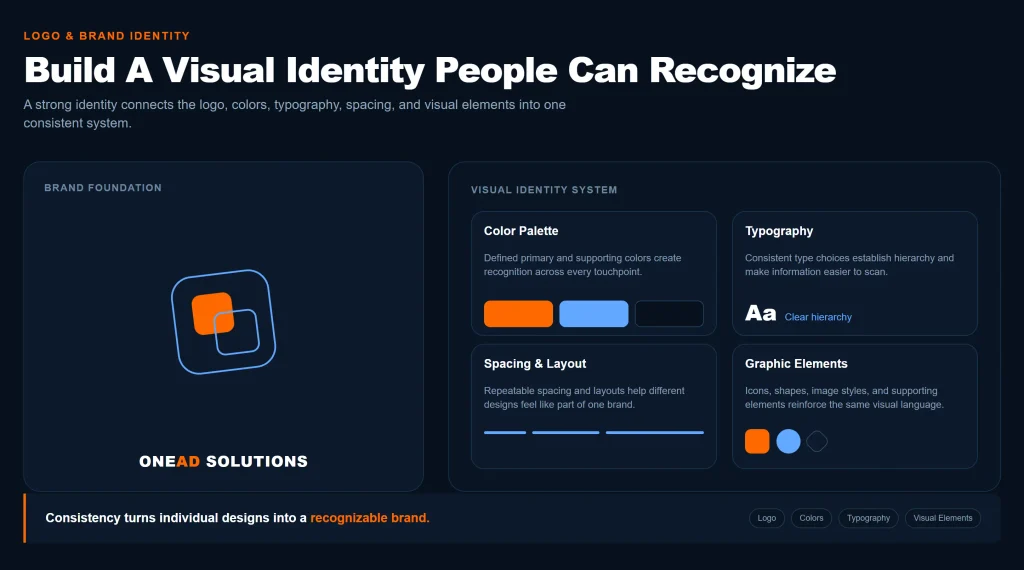
Brand identity and graphic design are closely connected.
Graphic design helps turn a brand’s identity into something people can see and recognize. The logo may be the most obvious element, but a brand’s visual identity also includes its colors, typography, imagery, layouts, and other design elements.
These elements work together across the customer journey. A person might first see a social media post, then visit the website, see an advertisement, and later receive a brochure or presentation. When the visual language remains consistent, these different experiences feel connected to the same business.
This does not mean every design should look identical. A strong visual identity provides a framework while still allowing different designs to fit different platforms, messages, and campaigns.
A brand needs a consistent visual system so that customers can recognize it across different touchpoints.
Imagine a business using blue and white on its website, completely different colors on Instagram, another font on its advertisements, and a different logo style on printed materials.
Even if every individual design looks acceptable, the overall brand may feel disconnected.
A visual identity can solve this by establishing rules for how the brand should appear.
These rules may cover:
- Primary and secondary colors
- Fonts
- Logo usage
- Image styles
- Icon styles
- Spacing
- Backgrounds
- Design layouts
Once these elements are established, creating new marketing materials becomes easier because the designer has a clear visual direction to follow.
Graphic Design and Digital Marketing
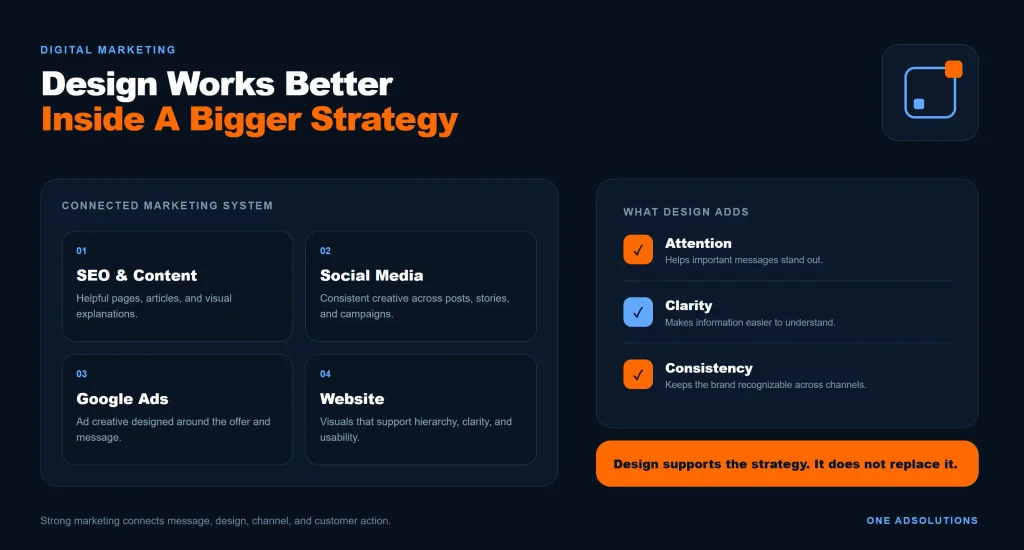
Graphic design plays a role in many areas of digital marketing.
Different marketing channels also require different types of visual content. Social media may need posts, stories, carousels, and promotional graphics, while advertising campaigns may require several creative formats for different placements.
Websites may use banners, illustrations, icons, infographics, and other visual elements to support their content. Email marketing can use branded graphics to highlight an offer or important information, while content marketing can use diagrams and visual explanations to make complex topics easier to understand.
The purpose of the design should always match the purpose of the marketing activity. A graphic created to explain a concept does not need to use the same approach as an advertisement designed to generate enquiries.
The visual style can still remain consistent across these channels. Using the same brand colors, typography, imagery, and design elements helps connect different pieces of marketing content to the same business.
It can support:
- SEO content
- Social media marketing
- Google Ads
- Website marketing
- Email marketing
- Content marketing
- Local marketing
- Promotional campaigns
If you want to understand how graphic design fits alongside these other channels, our Digital Marketing Guide explains how different digital marketing activities can work together as part of a broader marketing system.
The important point is that design does not replace marketing strategy.
Instead, it helps present that strategy visually.
For example, a marketing campaign may have a clear target audience, offer, message, and call to action. Graphic design helps turn those decisions into visuals that can be used across different platforms.
Graphic Design for Social Media Marketing
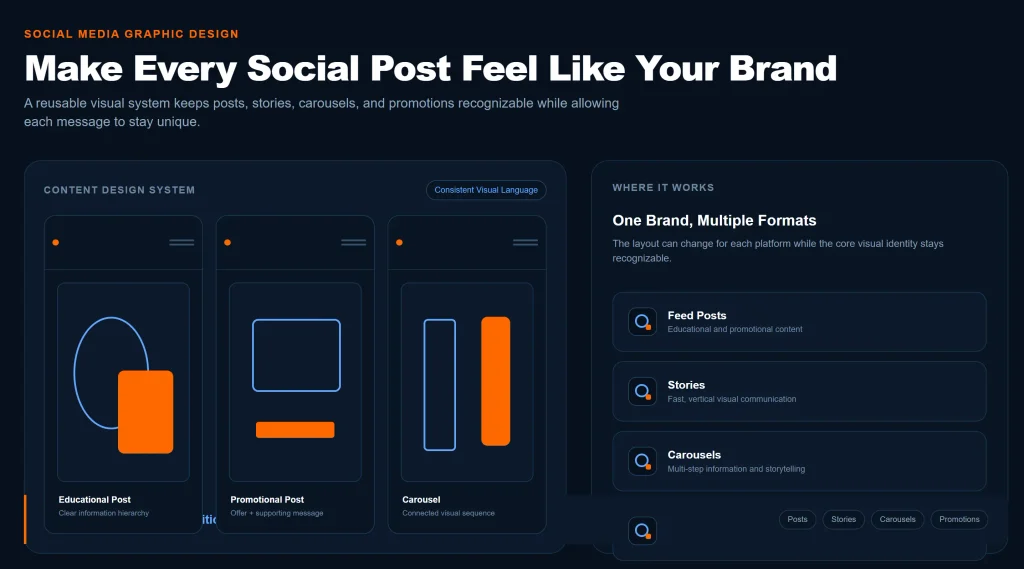
Social media gives businesses many opportunities to communicate visually.
However, posting random graphics is not the same as having a social media design system.
A consistent social media design system may use:
- A defined color palette
- Consistent typography
- Reusable layouts
- Brand elements
- Consistent image treatment
- Clear content hierarchy
This allows different posts to feel connected.
Educational Social Media Graphics
Not every social media post needs to sell something.
Educational graphics can explain concepts, answer questions, share tips, or provide useful information.
For example, an SEO agency might create a carousel explaining common technical SEO issues.
The design should make each point easy to read while keeping the visual identity consistent.
Promotional Graphics
Promotional graphics have a different purpose.
They may focus on:
- A service
- A discount
- A product
- An event
- A limited-time offer
- A new launch
Here, the offer and call to action usually need stronger visual emphasis.
The design should make the purpose of the post immediately clear.
Graphic Design for Advertising
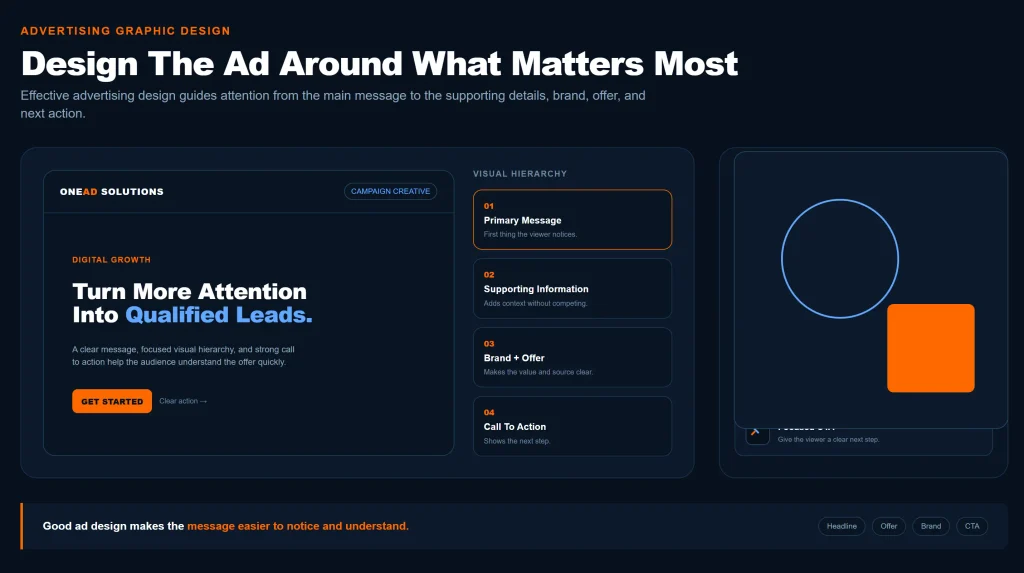
Advertising design needs to balance attention and clarity.
A graphic can be visually impressive but still fail if the viewer cannot understand the message.
A useful advertising design usually establishes a visual hierarchy.
For example:
Primary: Main offer or message
Secondary: Supporting information
Tertiary: Brand details or additional information
The viewer should naturally notice the most important information first.
This becomes especially important for paid advertising because the design is part of the overall advertisement experience.
A strong campaign can also use a consistent visual system across multiple advertisements so that different creatives still feel like part of the same campaign.
Graphic Design for Websites
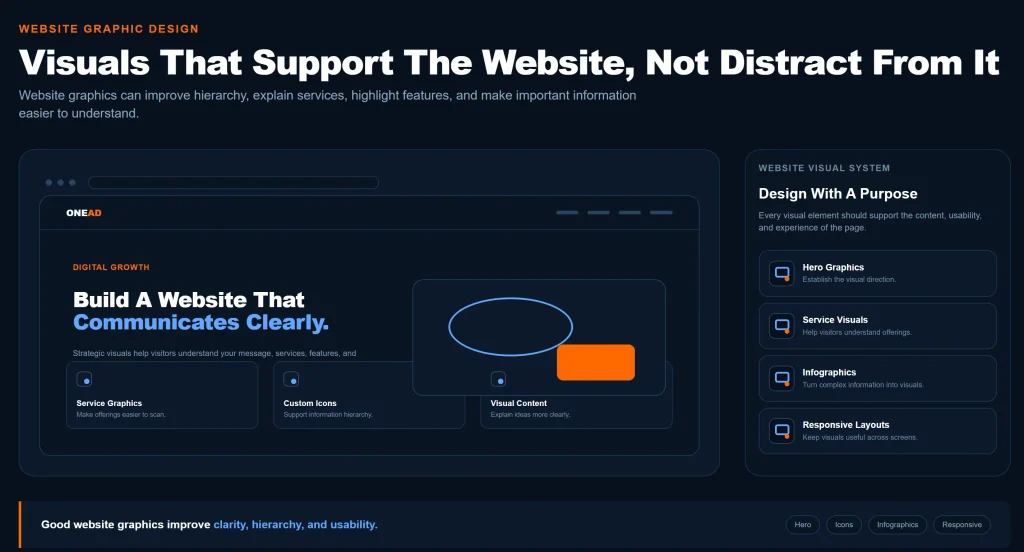
Website design involves more than choosing colors and making pages look attractive.
Graphic design can help visitors understand where to look first, what information is important, and what action they can take next.
This can be achieved through:
- Typography to create clear headings and readable content
- Spacing to separate different sections
- Colors to highlight important elements
- Images and illustrations to support the content
- Icons to explain features or services
- Layout to create a clear flow through the page
A well-organized visual hierarchy makes a website easier to understand without overwhelming the visitor.
Designing Different Website Elements
Different parts of a website may require different types of graphic design.
For example:
- Homepage: Hero graphics, illustrations, and visual sections can introduce the business and its main services.
- Service pages: Icons, diagrams, and supporting graphics can help explain individual services.
- Blog posts: Featured images, diagrams, and infographics can make information easier to understand.
- Landing pages: Visual elements can support the main offer and help direct visitors toward the desired action.
- About pages: Photography, illustrations, and brand elements can help communicate the company’s identity.
The design should always support what the visitor needs to understand on that specific page.
Communicating Services Visually
Graphic design can also help businesses explain their services without relying entirely on text.
A website development company might use custom icons to explain its development process. A restaurant could use high-quality food photography to present its menu or promotions. A software company might use diagrams to explain how its product works.
The goal is not to add graphics simply because a page needs more visuals. Each visual should have a clear purpose and support the information around it.
Maintaining Brand Consistency
Website graphics should follow the same visual identity as the rest of the brand.
This can include:
- Brand colors
- Typography
- Image styles
- Icon styles
- Logo usage
- Spacing and layouts
- Other recurring visual elements
Consistent design helps the website feel connected to the business’s social media, advertisements, presentations, and other marketing materials.
Avoiding Unnecessary Visual Clutter
Adding too many graphics can make a website harder to use. Large images, decorative elements, excessive icons, or competing visual styles can distract visitors from the actual content.
Good website graphic design should:
- Support the content
- Improve visual organization
- Make important information easier to find
- Guide visitors through the page
- Avoid unnecessary decoration
The design depends on what the visitor needs to understand. Good website graphic design combines visual communication with usability so that the website looks organized while remaining easy to navigate.
Graphic Design for Promotional Materials
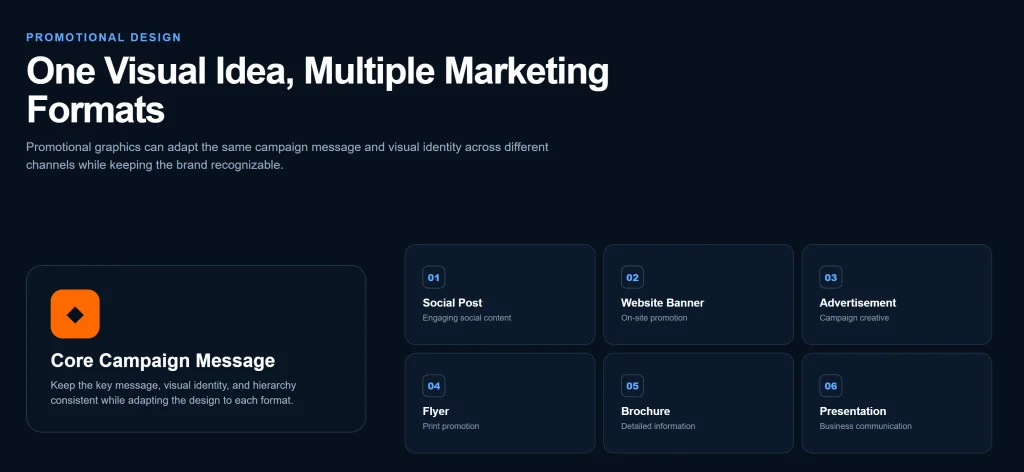
Businesses often need the same information in different formats. A single promotion or campaign may need to appear across social media, websites, advertisements, printed materials, and presentations.
Common Promotional Materials
Depending on the campaign, a business may need:
- Social media posts for promotions, announcements, and campaigns
- Website banners to highlight offers or important messages
- Flyers and brochures for printed marketing
- Advertisements for paid campaigns
- Presentation slides for sales meetings or business presentations
- Promotional graphics for events, launches, and special offers
Creating each design separately can result in inconsistent messaging and branding. Different colors, fonts, images, or layouts can make the same campaign feel disconnected across different platforms.
Creating a Consistent Campaign
A better approach is to create a core visual concept and adapt it to different formats.
The main elements can remain consistent, including:
- Main message
- Brand colors
- Typography
- Imagery
- Logo and brand elements
- Overall visual style
The layout can then be adjusted according to the platform. A social media graphic may need a compact design, while a brochure can include more information. A website banner may need to focus on a short message and clear call to action.
Digital and Print Requirements
Promotional materials also need to consider where and how the design will be used.
Digital and printed materials can have different technical requirements, including:
- Dimensions and aspect ratios
- Image resolution
- File formats
- Color settings
- Print specifications
For example, a social media graphic may be prepared as a digital image, while a flyer or brochure may require a print-ready PDF.
Preparing the correct files helps ensure that the design works properly on its intended platform.
Keeping the Main Message Clear
Promotional design should make the most important information easy to find.
A useful visual hierarchy can give attention to:
- The main offer or message
- Supporting information
- The call to action
- Relevant brand or contact details
This helps the audience understand the promotion quickly without having to search through unnecessary visual elements.
Good promotional graphic design keeps the campaign recognizable, consistent, and appropriate for each platform and purpose.
What Makes Good Graphic Design?
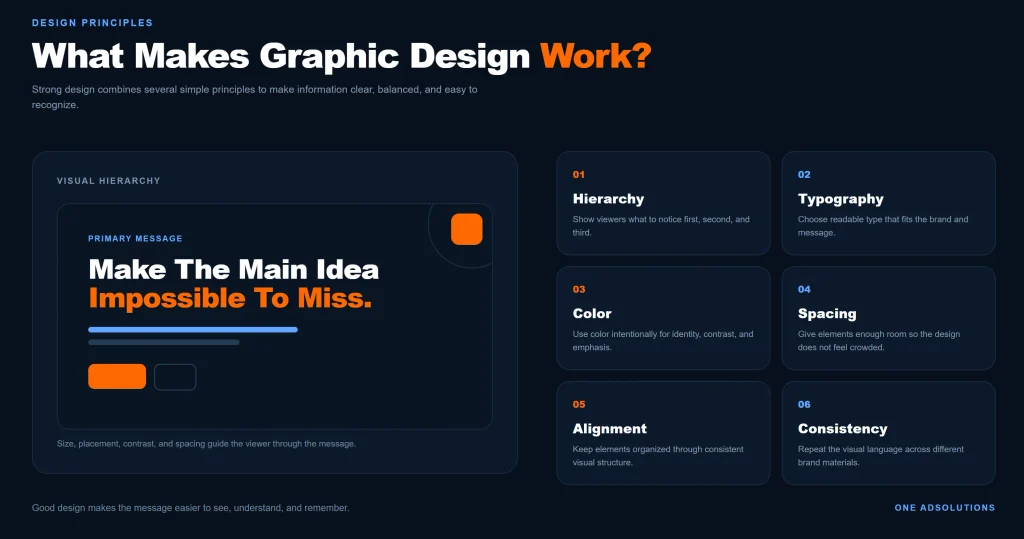
Good graphic design is not simply about adding attractive elements.
Several principles help determine whether a design communicates effectively.
Visual Hierarchy
Visual hierarchy controls the order in which people notice information.
Size, spacing, contrast, positioning, and typography can all influence hierarchy.
The most important message should normally receive the strongest visual emphasis.
Typography
Typography affects both readability and visual character.
Using too many fonts can make a design look disorganized.
In many cases, a small number of well-selected typefaces is enough.
Typography should also be readable at the actual size where the design will be viewed.
Color
Colors can help organize information and maintain brand consistency.
A brand may have a primary color, secondary colors, and neutral colors.
The important thing is not simply choosing colors that look good together. They also need to provide enough contrast and work across different applications.
Spacing
Spacing gives elements room to breathe.
When every part of a design is pushed together, the viewer may struggle to understand the structure.
Good spacing separates related information and creates a clearer layout.
Alignment
Alignment helps create order.
Text, images, icons, and other elements should have a logical relationship with one another.
Even small alignment problems can make a design feel unfinished.
Consistency
A business should have recognizable visual patterns.
Consistency across designs helps connect different marketing materials to the same brand.
The Graphic Design Process
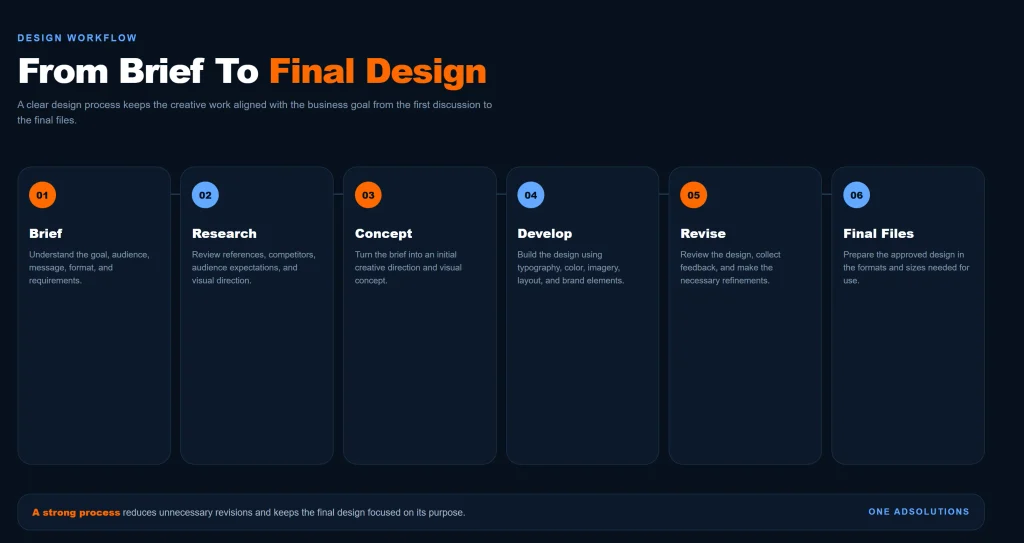
Professional graphic design normally follows a structured process.
Step 1: Understand the Brief
Before designing anything, the designer needs to understand the purpose of the project.
Important questions include:
- What is the design for?
- Who will see it?
- What message needs to be communicated?
- Where will it be used?
- What action should the viewer take?
- Are there existing brand guidelines?
A clear brief reduces unnecessary revisions later.
Step 2: Research and References
The designer studies the business, audience, competitors, industry, and design requirements.
References may also be collected to establish a visual direction.
Research does not mean copying another company’s design.
It helps the designer understand the visual environment in which the design will be used.
Step 3: Create the Initial Concept
The designer develops an initial visual direction.
This can include:
- Layout ideas
- Typography
- Colors
- Imagery
- Supporting elements
At this stage, the goal is to establish the overall concept.
Step 4: Develop the Design
Once the direction is selected, the designer develops the actual design.
Elements are arranged, typography is refined, imagery is selected, and the visual hierarchy is adjusted.
Step 5: Review and Revise
The client reviews the design and provides feedback.
Good feedback should be specific.
For example:
“Make the headline larger and move the call to action higher.”
is more useful than:
“Make it better.”
Revisions should improve the design while keeping the original objective in mind.
Step 6: Prepare Final Files
Once the design is approved, the files are prepared for their intended use.
Different formats may be required for different purposes.
For example:
- PNG or JPG for certain digital uses
- PDF for documents and printing
- SVG for scalable vector graphics
- Editable source files for future changes
The correct file format depends on how the design will be used.
Common Graphic Design Mistakes
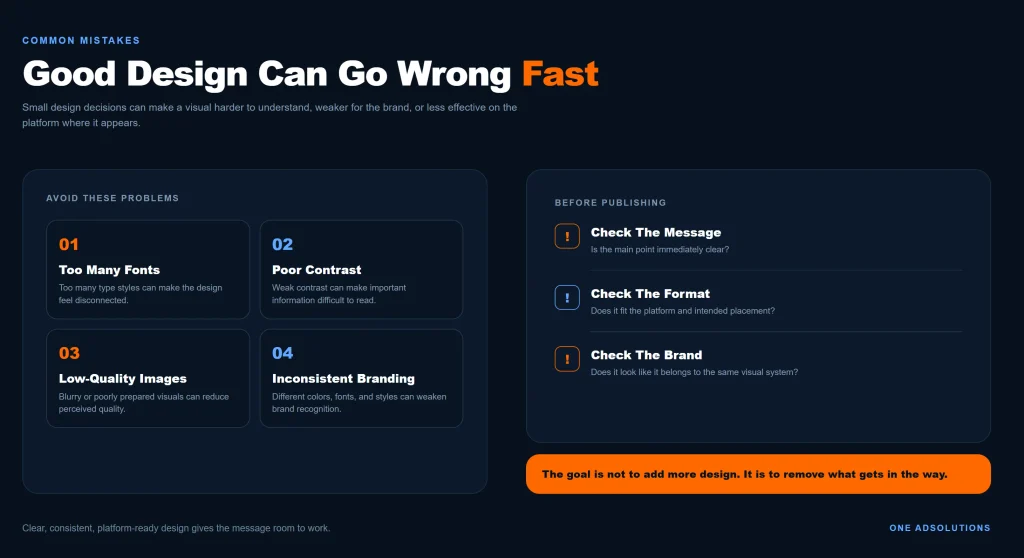
Even a well-planned project can go wrong if basic design principles are ignored.
Using Too Many Fonts
Multiple fonts can make a design look inconsistent.
A simple typography system is usually easier to manage.
Making Everything Important
If every heading, image, button, and word is large and bold, nothing stands out.
Good design creates a clear priority.
Using Low-Quality Images
Low-resolution images can make a professional design look poor.
Images should be appropriate for the final size and platform.
Poor Contrast
Text should be easy to read against its background.
Low contrast can make important information difficult to see.
Ignoring Platform Dimensions
A design should be created for its intended platform.
A social media story, website banner, advertisement, and printed flyer all have different requirements.
Inconsistent Branding
Changing colors, fonts, logos, and design styles from one piece of content to another can weaken visual consistency.
Copying Trends Without Considering the Brand
A design trend may look popular, but that does not mean it is appropriate for every business.
The design should fit the brand, audience, and purpose.
Designing Without a Clear Objective
Before starting a design, there should be a reason for creating it.
A beautiful graphic that does not communicate the intended message is still a weak marketing asset.
Graphic Design and SEO
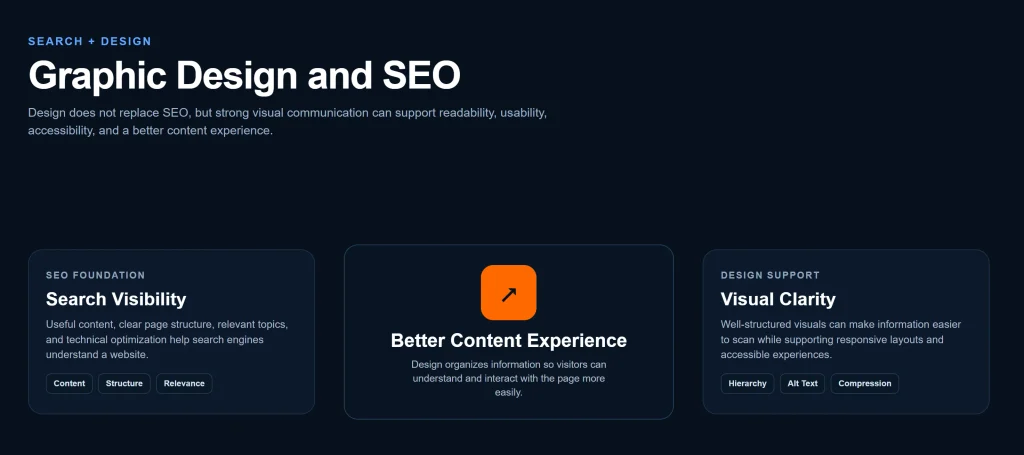
SEO focuses on helping pages become more visible in search results, while design focuses on how information is presented visually. They serve different purposes, but they can work together to create a better overall content experience.
A well-designed page does not automatically rank higher in search results. However, thoughtful visual content can support readability, usability, accessibility, and the way visitors interact with a page.
For example, properly prepared images can support:
- Content readability
- Page organization
- User experience
- Visual explanations
- Accessibility
- Content engagement
Images should also be prepared properly for websites.
Large, unnecessarily heavy image files can affect page performance. Appropriate file formats, dimensions, compression, and descriptive alternative text can help create a better overall implementation.
The goal is to use design where it improves the content rather than adding images simply because a page needs more visuals.
Graphic Design for Different Business Goals
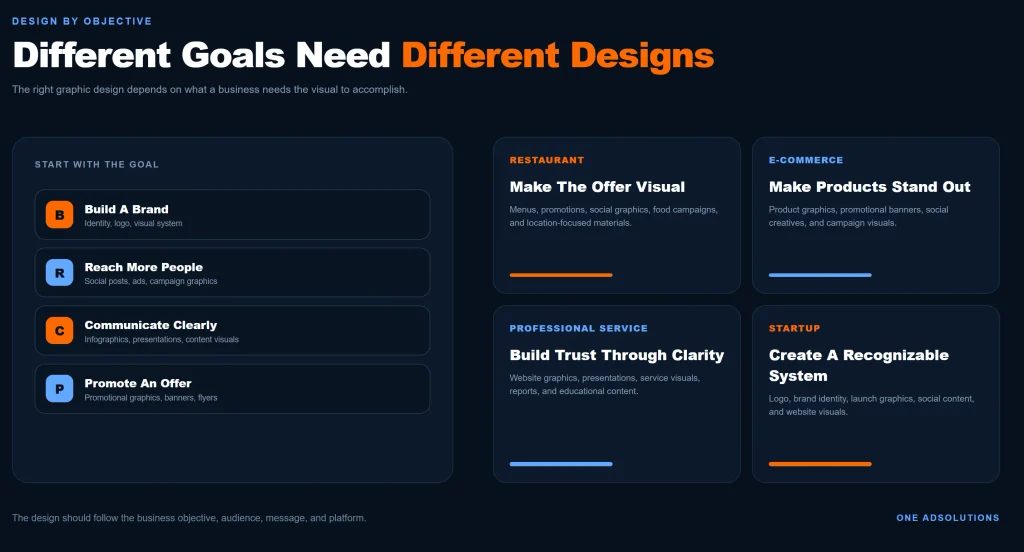
Different businesses use graphic design for different purposes. A restaurant may need promotional graphics for a seasonal offer, while a professional service company may need visual content to explain complex information.
The design should start with the business objective, target audience, and message rather than simply following a visual trend.
Restaurants
Restaurants can use graphic design for:
- Menus and menu promotions
- Food photography layouts
- Social media graphics
- Special offers
- Seasonal campaigns
- Event promotions
The goal may be to make a particular dish, offer, or event immediately noticeable while keeping the brand recognizable.
Online Stores
Online stores often need visual content throughout the customer journey.
Common examples include:
- Product graphics
- Website banners
- Promotional advertisements
- Sale and discount graphics
- Product comparison visuals
- Social media content
Clear product-focused design can help customers understand what is being offered and find important information more easily.
Professional Services
Professional service businesses may use graphic design for:
- Presentations
- Brochures
- Social media graphics
- Website visuals
- Infographics
- Brand identity materials
For these businesses, design can be especially useful for explaining services, presenting information clearly, and building a consistent visual identity.
Startups
Startups often need to establish a visual identity while building their marketing presence.
Their design needs may include:
- Logo and brand identity
- Website graphics
- Social media content
- Pitch decks
- Marketing materials
- Advertising creatives
A consistent visual system can help a new business maintain the same identity across different channels as its marketing grows.
Start With the Goal
The same design approach will not work for every business because the purpose of the visual can be different.
Before creating a graphic, it helps to identify whether the goal is to:
- Inform
- Promote
- Explain
- Build brand recognition
- Encourage an action
This gives the designer a clearer direction and helps determine the appropriate layout, imagery, typography, and visual hierarchy.
The best design is not simply the one that looks attractive. It is the one that supports the specific goal, audience, and message of the business.
How Much Does Graphic Design Cost?
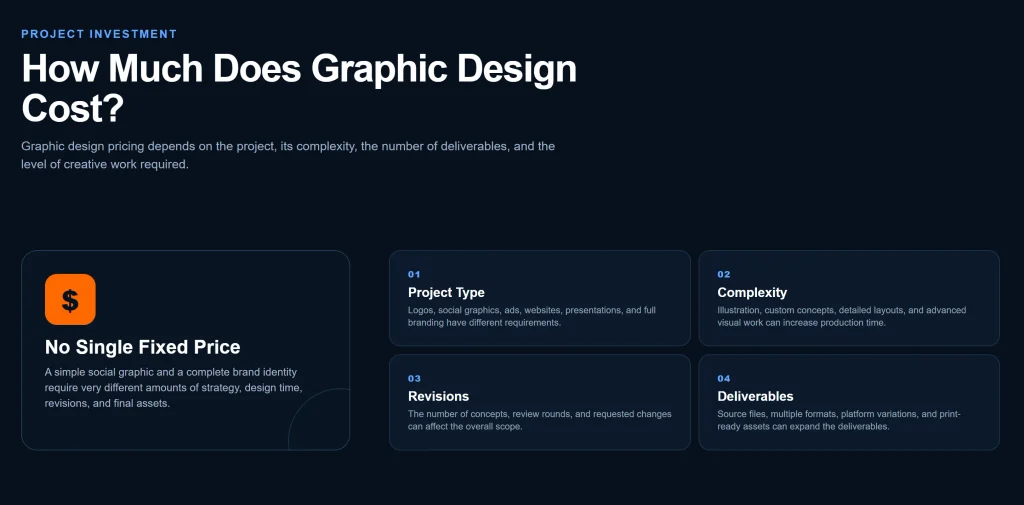
There is no single price for graphic design. The cost depends on the type of project, amount of work, complexity, and required deliverables.
A simple social media graphic will usually require a different level of work than a complete brand identity, advertising campaign, or custom illustration.
Factors That Affect Graphic Design Cost
Several factors can influence the total cost of a project, including:
- Type of design: Logos, social media graphics, advertisements, brochures, presentations, and brand identity projects have different requirements.
- Project complexity: Detailed illustrations and custom graphics generally require more design work than simple layouts.
- Number of concepts: Some projects may require multiple initial concepts before a final direction is selected.
- Revisions: The number of revision rounds can affect the overall amount of work.
- File formats: Different platforms and uses may require multiple final file formats.
- Custom illustrations: Original illustrations or icons can require additional design time.
- Photography: Projects involving custom photography or image preparation may have additional requirements.
- Branding: A complete visual identity involves more work than creating an individual graphic.
- Turnaround time: Urgent projects may require a faster production schedule.
- Editable source files: Some projects require the original design files so they can be edited later.
Why Project Requirements Matter
Two businesses can request a similar type of design but have very different requirements.
For example, one business may need a single promotional graphic, while another may need a complete campaign with multiple sizes, variations, revisions, and platform-specific designs.
This is why comparing design services based only on the initial price can be misleading. It is more useful to compare what is included in the project.
What to Confirm Before Starting
Before beginning a graphic design project, businesses should clarify:
- What designs are included
- How many concepts are provided
- How many revisions are included
- Expected delivery timeline
- Final file formats
- Whether editable source files are included
- Any additional costs for extra work
A clear agreement helps both sides understand the scope, deliverables, timeline, and revision process before the project begins.
How to Choose a Graphic Design Company
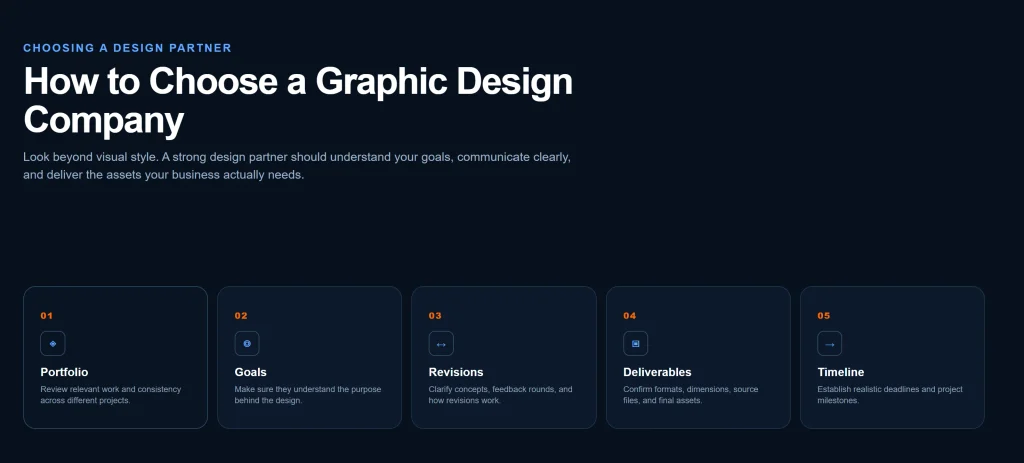
Choosing a graphic design company involves more than looking at attractive designs. The right choice depends on your business goals, project requirements, communication, and the type of design work you need.
Review the Portfolio
A portfolio can show how a design company handles different projects, industries, formats, and visual styles.
Look for:
- Quality and consistency
- Different types of design work
- Strong visual hierarchy
- Clear and readable layouts
- Designs that match their intended purpose
A portfolio should give you an idea of what the company can create and whether its approach fits your project.
Understand Your Goal
Before hiring a designer, be clear about what you want the design to achieve.
For example, your goal may be to:
- Build brand recognition
- Promote a service
- Explain information
- Improve social media content
- Support an advertising campaign
- Create a professional presentation
A clear objective makes it easier to communicate your requirements and evaluate the final design.
Ask About Revisions
Different design companies may have different revision policies.
Before starting, ask:
- How many revision rounds are included?
- How are revisions requested?
- What counts as a revision?
- What happens if additional revisions are needed?
Understanding the revision process can help avoid confusion later.
Check the Deliverables
Make sure you know which files you will receive at the end of the project.
Depending on the design, you may need:
- PNG or JPG files
- PDF files
- SVG or other vector formats
- Different platform sizes
- Print-ready files
- Editable source files
The required deliverables depend on how you plan to use the design.
Consider Timelines
Ask about the expected design and delivery timeline before starting the project.
A simple graphic may have a different turnaround time from a complete branding project or a campaign involving multiple designs.
If you have a launch date, advertising schedule, or printing deadline, communicate it early.
Look for Consistency
If you need multiple designs, consistency becomes especially important.
A graphic design company should be able to maintain a recognizable visual system across:
- Social media
- Websites
- Advertisements
- Presentations
- Brochures
- Other marketing materials
This helps different pieces of content feel like part of the same brand.
For businesses looking for professional design support, you can explore our Graphic Design Services to see the types of design work available.
How Graphic Design Supports a Complete Marketing Strategy
Graphic design works best when it is connected to the rest of a business’s marketing strategy. Instead of treating each graphic as a separate project, businesses can use design to create a consistent visual experience across different marketing channels.
Connecting Design With Marketing Channels
A marketing campaign may involve several different channels, such as:
- Website pages that explain the offer or service
- SEO content that attracts people through search
- Social media posts that build awareness and engagement
- Paid advertisements that promote specific offers
- Email marketing that communicates directly with an audience
- Promotional materials that support campaigns and sales activities
Graphic design can support each of these channels while maintaining the same visual identity.
Example of a Connected Campaign
Imagine a business launching a new service. The marketing campaign could include:
- A website page explaining the service
- SEO content targeting relevant search queries
- Social media graphics introducing the service
- Paid advertisements promoting the offer
- Ad creatives adapted for different platforms
- Visual content on the website supporting the service information
- Promotional materials for additional marketing activities
The designs do not need to be identical. Instead, they can share common colors, typography, imagery, messaging, and visual elements.
Why Consistency Matters
When marketing materials use a consistent visual system, people can more easily recognize that different pieces of content belong to the same business.
For example, someone might first see a social media advertisement, later visit the website, and then receive an email from the same company. Consistent design can make these different interactions feel connected rather than unrelated.
Design Should Support the Strategy
Graphic design does not replace marketing strategy. It helps present the strategy visually.
Before creating a graphic, businesses should understand:
- Who the target audience is
- What the main message is
- What the offer or information is
- What action the audience should take
- Where the design will be used
This allows the design to support the actual marketing objective instead of simply making content look attractive.
A connected approach helps businesses use graphic design as part of a broader marketing system rather than treating it as an isolated visual task.
For businesses that need multiple marketing services together, you can explore our All Services page.
Graphic Design vs Branding
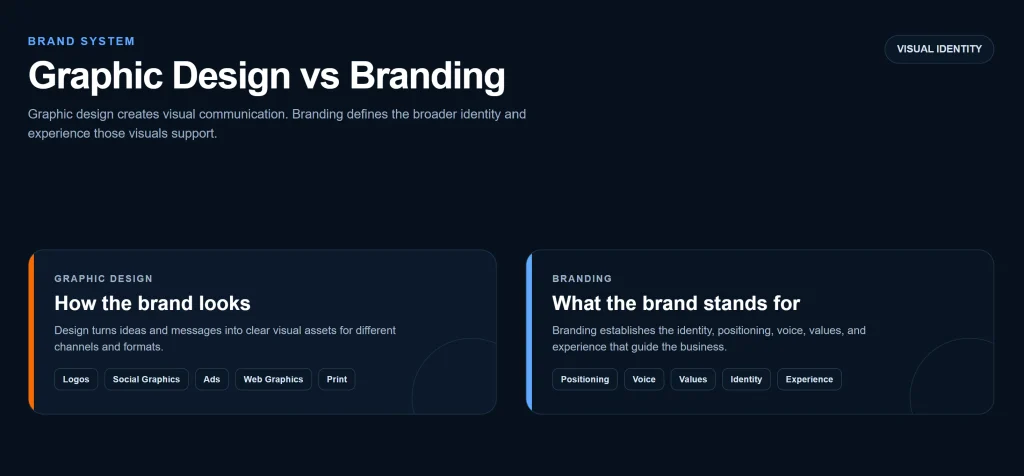
Graphic design and branding are related, but they are not exactly the same thing.
Branding is the broader process of defining how a business presents itself and how it wants to be recognized by its audience.
Graphic design focuses more specifically on creating visual materials that communicate the brand, its messages, or its offers.
What Does Branding Include?
Branding can involve many parts of a business’s identity and communication, including:
- Brand positioning
- Brand voice
- Messaging
- Values
- Visual identity
- Customer experience
- Brand guidelines
These elements help establish how a business communicates and presents itself across different customer touchpoints.
For example, a brand may define its target audience, communication style, key messages, colors, typography, and overall visual direction.
What Does Graphic Design Include?
Graphic design turns visual ideas and brand elements into specific marketing and communication materials.
This can include:
- Logos
- Social media graphics
- Advertisements
- Website graphics
- Brochures
- Presentations
- Infographics
- Promotional materials
A designer uses elements such as color, typography, imagery, layout, shapes, and visual hierarchy to create these materials.
How Do They Work Together?
Branding provides the broader direction, while graphic design helps turn that direction into visual communication.
For example, a business may establish a brand identity with specific colors, fonts, imagery, and visual guidelines. A graphic designer can then use those elements to create social media posts, advertisements, website graphics, brochures, and other marketing materials.
The two work together to create a consistent visual experience across different platforms.
Branding defines the broader identity and direction.
Graphic design turns parts of that identity into visual communication.
Understanding this difference helps businesses see why creating a logo alone is not the same as building a complete brand identity.
Frequently Asked Questions About Graphic Design
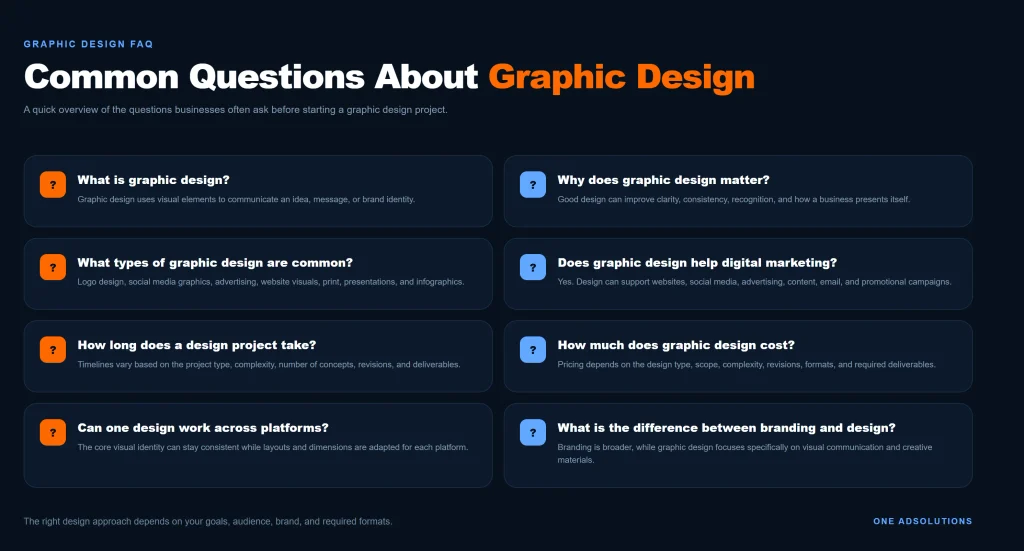
What is graphic design?
Graphic design is the process of using visual elements such as typography, color, imagery, shapes, and layouts to communicate information or ideas.
Why is graphic design important for businesses?
Graphic design helps businesses communicate visually, maintain brand consistency, organize information, and create marketing materials for different platforms.
What types of graphic design do businesses need?
Common types include logo and brand identity design, social media graphics, advertising creatives, website graphics, brochures, flyers, presentations, infographics, packaging, and promotional materials.
Is graphic design part of digital marketing?
Yes. Graphic design supports several areas of digital marketing, including social media, advertising, websites, content marketing, and promotional campaigns.
Does graphic design improve SEO?
Graphic design does not directly guarantee better search rankings. However, properly implemented visual content can support readability, usability, accessibility, and the overall quality of a webpage.
How long does graphic design take?
The timeline depends on the type and complexity of the project. A simple graphic may take much less time than a complete brand identity or a large campaign with multiple designs.
How much does graphic design cost?
The cost depends on factors such as project complexity, number of designs, revisions, deliverables, custom illustrations, and turnaround requirements.
What files should a designer provide?
The required files depend on the project. Common formats include JPG, PNG, PDF, SVG, and editable source files where applicable.
Can one design be used on multiple platforms?
A design can often be adapted for different platforms, but it may need changes to dimensions, layout, text size, and composition so that it works properly in each format.
What is the difference between graphic design and branding?
Branding is the broader process of defining a company’s identity and presentation. Graphic design focuses on creating visual materials that communicate that identity and its messages.
Final Thoughts
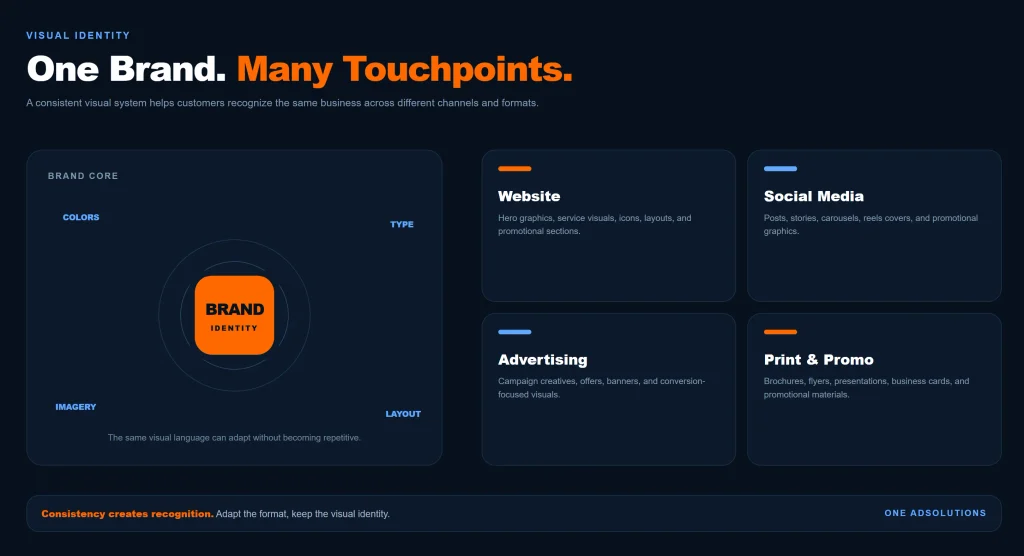
Graphic design is more than making a business look good.
It is a form of visual communication that helps businesses present information, promote services, build consistency, and communicate with their audience across different channels.
From logos and brand identity to social media graphics, advertisements, websites, brochures, presentations, and infographics, design can support many parts of a business’s marketing system.
The most effective approach is to design with a purpose.
Every graphic should have a clear message, a defined audience, and an appropriate format. When the visual identity remains consistent across different marketing channels, individual designs can work together as part of a larger brand system.
For businesses that want to improve their visual communication and create professional marketing materials, OneAdSolutions provides digital marketing and creative services designed to support different stages of online growth.
Explore our Graphic Design Services to learn more about the design support available for your business.