
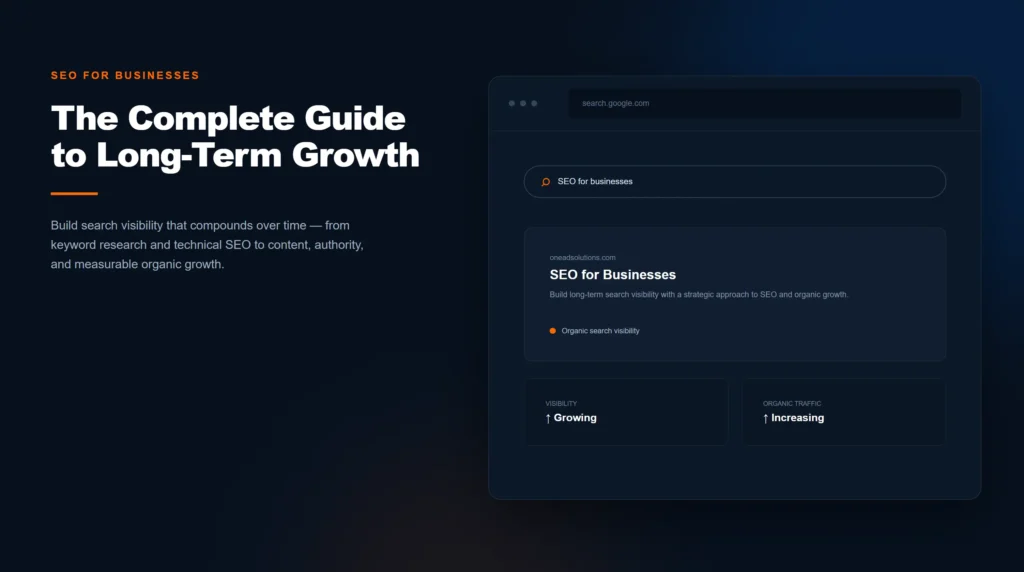
Getting traffic from Google is not simply about adding keywords to a website and waiting for rankings.
For businesses, effective SEO is a combination of understanding what people search for, creating useful content, building a technically strong website, earning authority, and continuously improving based on real search data.
A business might have a great website, strong services, and an excellent product, but if potential customers cannot find it in search results, much of that value stays hidden.
For businesses working with an agency like One Ad Solutions, SEO can provide a structured approach to building that visibility over time.
That is where SEO comes in.
Search engine optimization helps businesses build visibility for the searches that matter to them. Unlike paid advertising, where visibility generally stops when the campaign stops, a strong SEO strategy can continue attracting relevant visitors over time.
But sustainable SEO is not one task. It is a system made up of several connected parts.
In this guide, we will break down the most important parts of SEO for businesses, from keyword research and on-page optimization to technical SEO, content, internal linking, local search, authority building, and measuring results.
1. Understanding the Fundamentals of SEO
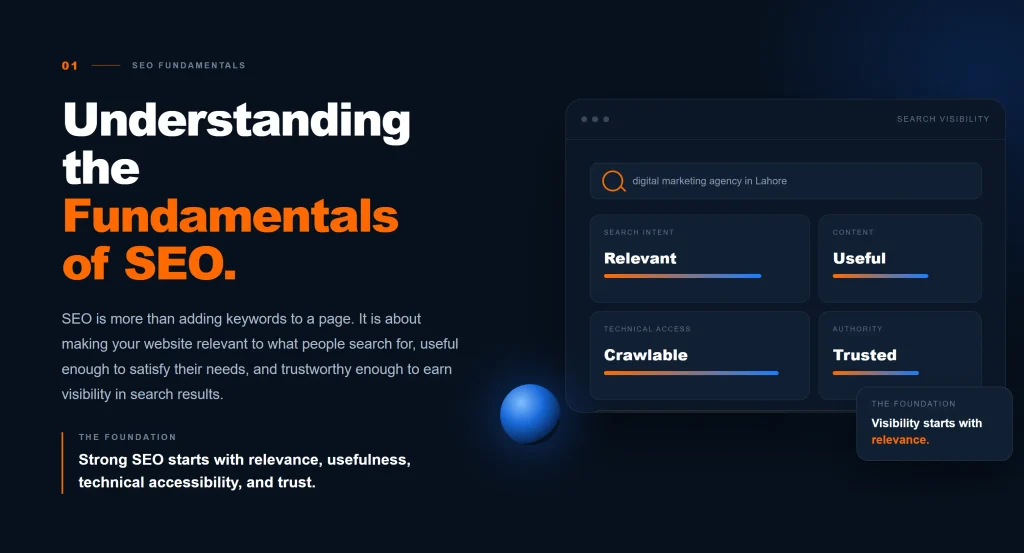
SEO, or search engine optimization, is the process of improving a website so that search engines can better understand its content and users can find it through relevant searches.
Think about what happens when someone searches:
“digital marketing agency in Lahore”
Google has to determine which pages are the most relevant and useful for that search.
It considers many signals, including:
- The content on the page
- The search intent behind the query
- Website structure
- Page experience
- Technical accessibility
- Topical relevance
- Internal links
- External authority
- Local relevance
- Overall trustworthiness
This is why SEO is much bigger than simply placing a keyword on a page.
A business selling accounting services, for example, should not only optimize its homepage for “accounting services.” It may also need useful pages covering tax services, bookkeeping, payroll, business accounting, and other topics its potential customers search for.
The goal is to create a website that clearly demonstrates:
What you offer → who you serve → what problems you solve → why users should trust you.
Good SEO makes that information easier for both search engines and potential customers to understand.
2. Keyword Research and Search Intent
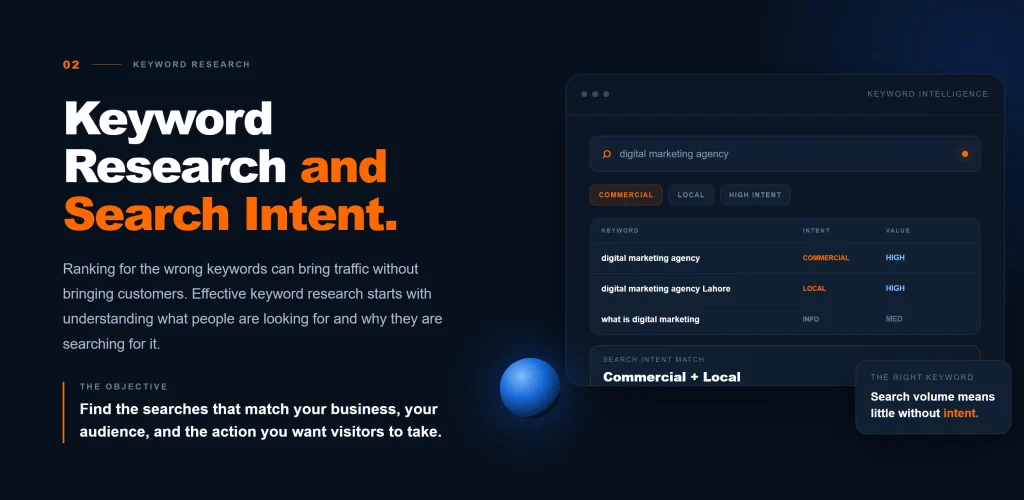
Before creating SEO content, businesses need to understand what their potential customers are actually searching for.
This is where keyword research comes in.
Keywords are not just phrases with high search volume. The most valuable keyword is often the one connected to a real business need.
For example, someone searching:
“what is SEO”
is probably looking for information.
Someone searching:
“SEO agency in Lahore”
may be comparing service providers.
Someone searching:
“hire SEO agency Lahore”
has an even stronger commercial intent.
These searches may all relate to SEO, but the user’s intent is different.
Search intent matters
A useful SEO strategy considers four common types of search intent:
Informational intent
The user wants to learn something.
Navigational intent
The user is trying to find a specific website, brand, or page.
Commercial investigation
The user is researching products or services before making a decision.
Transactional intent
The user is ready to take an action such as buying, booking, or contacting a business.
The content should match that intent.
A long educational article is usually better suited to an informational query, while a service page should focus on helping someone who is considering hiring that service.
Don’t build your strategy around keywords alone
Businesses should also look at related searches, questions, competitors, services, locations, and problems customers commonly mention.
This helps create a more complete SEO strategy instead of producing dozens of pages that target nearly identical keywords.
3. Building Strong On-Page SEO
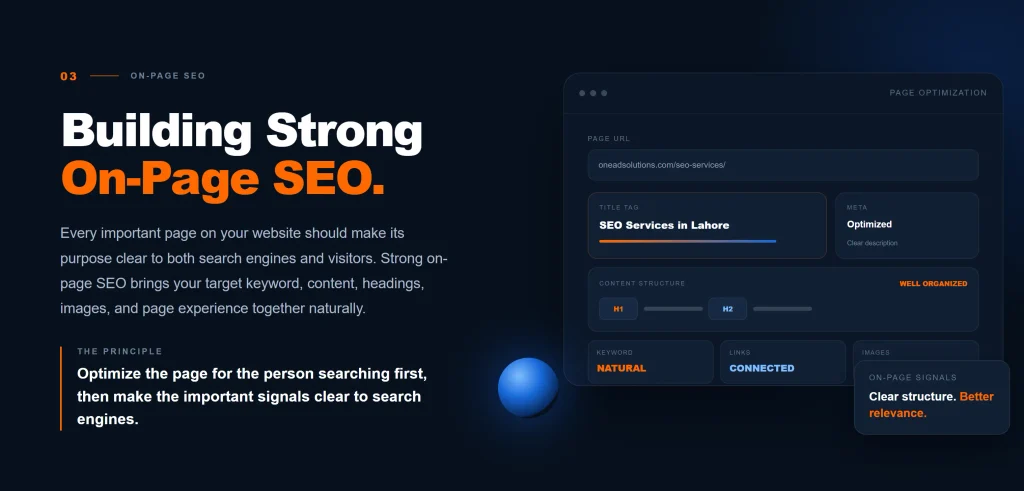
Once you know what people are searching for, the next step is making individual pages useful and understandable.
This is where on-page SEO becomes important.
A well-optimized page should make its subject clear without sounding like it was written specifically for a search engine.
Important elements include:
Page title
The title helps search engines and users understand what the page is about.
For a service page, a descriptive title such as:
SEO Services in Lahore | One Ad Solutions
is generally more useful than something vague like:
Our Services
Headings
Headings organize information and make longer pages easier to understand.
However they should follow the natural structure of the content rather than being added simply to insert keywords.
Content
The page should answer the questions a potential customer would reasonably have.
Instead of writing:
We provide the best SEO services with the best SEO strategies.
Explain what the service actually includes, who it is for, how the process works, and what the customer can expect.
Images
Relevant images can improve the visual experience of a page. Descriptive alt text can also help search engines understand images when appropriate.
Internal links
Relevant pages should connect to one another so users and search engines can discover related information.
The important principle is simple:
Optimize for clarity first, then make sure search engines can understand that clarity.
4. Technical SEO: Making the Website Easy to Crawl
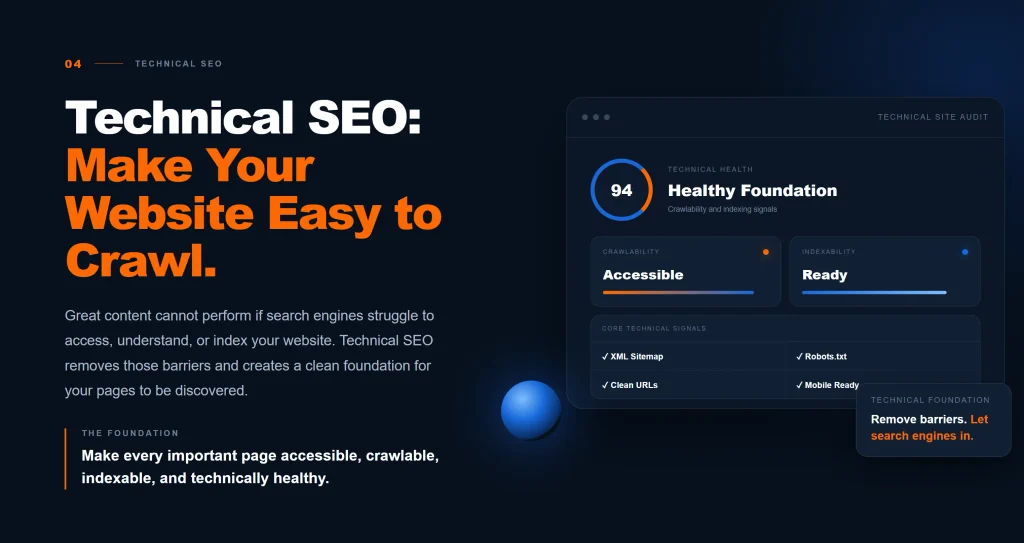
A website can have excellent content and still struggle in search if search engines have difficulty accessing or understanding its pages.
Technical SEO focuses on the infrastructure behind the content.
Some important areas include:
- Crawlability
- Indexability
- XML sitemaps
- Robots.txt
- Canonical URLs
- HTTPS
- Mobile usability
- Page speed
- Broken links
- Redirects
- Duplicate content
- Website architecture
- Structured data where appropriate
Crawling and indexing are different
Search engines first need to discover a page.
Then they need to decide whether the page should be included in their index.
This distinction matters.
A page can exist on your website but still not appear in Google’s search results.
Businesses should regularly monitor indexing and crawl issues through tools such as Google Search Console.
Website architecture matters too
Important pages should not be buried several layers deep.
A logical structure might look like:
Homepage → Service Category → Specific Service → Supporting Content
This makes it easier for users and search engines to move through the website.
Technical SEO isn’t about making a website complicated.
The best technical setup is usually the one that makes the website simpler to crawl, understand, and use.
5. Creating a Content Strategy Around Your Business
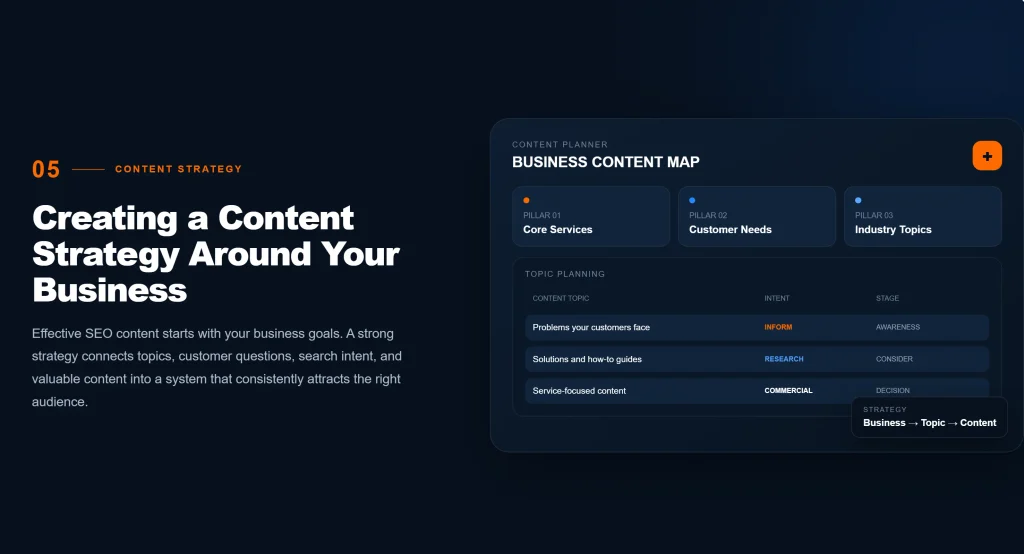
Publishing random blog posts is not the same as having an SEO content strategy.
Businesses should create content around the subjects that matter to their customers and services.
For example, an SEO agency could create content covering:
- SEO fundamentals
- Keyword research
- Technical SEO
- Local SEO
- Google Search Console
- On-page SEO
- Link building
- SEO mistakes
- SEO for small businesses
- Measuring SEO performance
But these articles should not exist as isolated pieces.
They should connect.
One comprehensive article can act as a central resource, while Digital Marketing Services can connect businesses with the broader strategies and services that support their online growth.
This creates a topic cluster.
For example:
Digital Marketing Guide
↓
SEO for Businesses
↓
Keyword Research
↓
Technical SEO
↓
Local SEO
↓
Internal Linking
↓
SEO Measurement
This structure gives users multiple ways to explore a subject while helping search engines understand the relationship between your content.
Quality matters more than publishing volume
A business does not need to publish five mediocre articles every week.
A smaller collection of genuinely useful content can be much more valuable than a large library of repetitive posts.
The question should always be:
Does this page provide something useful that the searcher would actually want to read?
6. Internal Linking: Connecting Your SEO Strategy
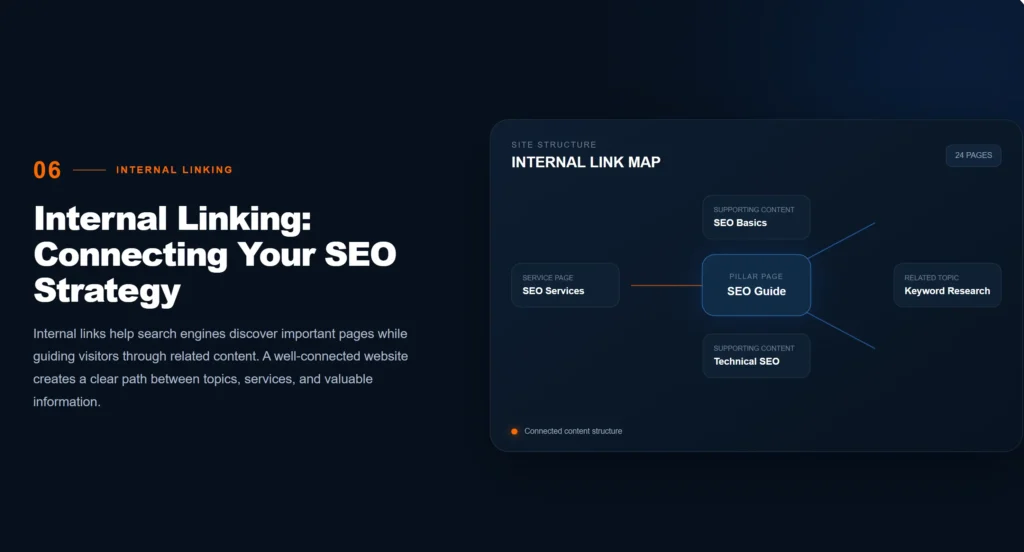
Internal links are links between pages on the same website.
They may look simple, but they play an important role in SEO.
Imagine someone reading an article about SEO for businesses.
Within that article, they see links to:
Keyword Research
Those links give readers an easy path to more relevant information.
They also help search engines discover related pages and understand how different pieces of content fit together.
Build links naturally
Internal links should make sense in context.
For example:
Businesses targeting customers in specific cities can benefit from a strong Local SEO strategy.
That is much more natural than adding a list of ten unrelated links at the bottom of every article.
Think of your website as a connected system
Your homepage should connect to important service pages.
Service pages can connect to relevant supporting content.
Blog articles can connect to other useful articles and the services they discuss.
This creates a clear path:
Information → Service → Action
That is much more valuable than treating every page as an isolated SEO project.
7. Local SEO for Businesses Targeting a Specific Area
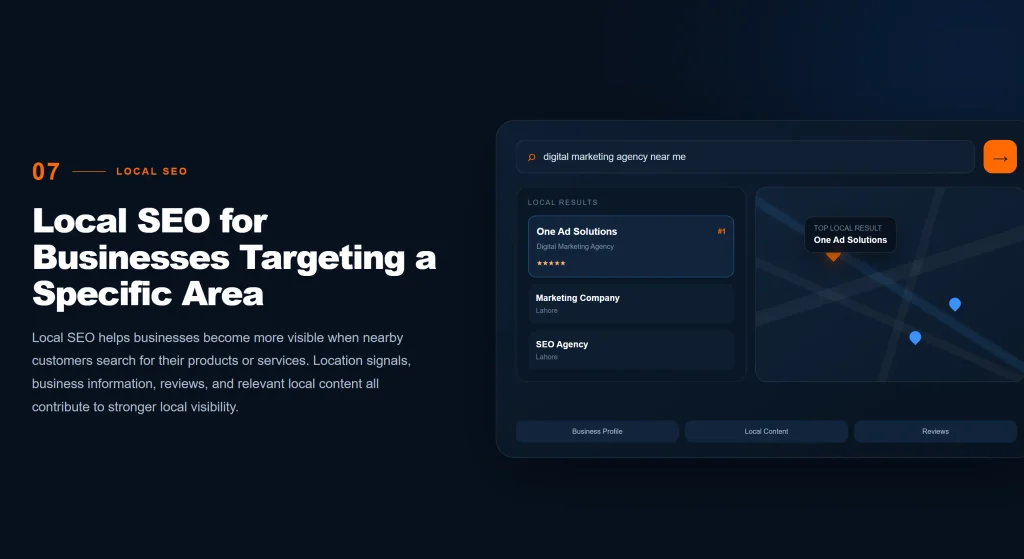
For businesses that serve a specific city or region, Local SEO can be one of the most valuable parts of their search strategy.
A customer searching:
“digital marketing agency in Lahore”
has a very different intent from someone searching:
“what is digital marketing?”
The first search includes a location and suggests that the user may be looking for a provider in that area.
Local SEO helps businesses become more visible for these geographically relevant searches.
Important areas include:
- Google Business Profile
- Consistent business information
- Local landing pages
- Location-relevant content
- Customer reviews
- Local citations
- Relevant local links
- Location-specific service information
But businesses should avoid creating dozens of nearly identical city pages just by replacing one city name with another.
A strong local page should actually provide useful information about serving customers in that location.
For a Lahore-based agency, for example, local relevance can be strengthened by clearly explaining the markets served, services offered, and business context relevant to Lahore.
8. Mobile Experience and Page Performance
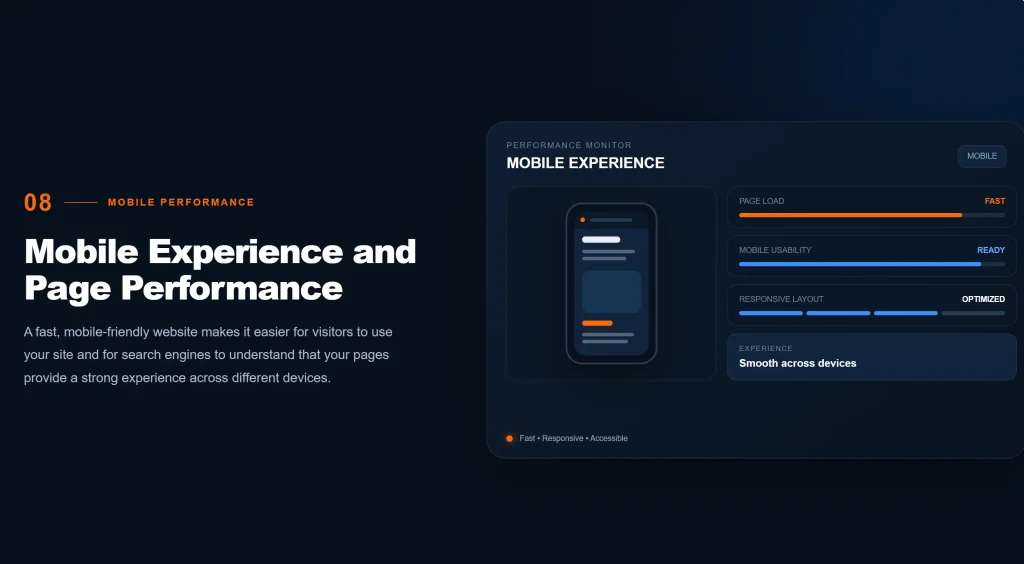
People do not experience websites only from desktop computers.
A large amount of search activity happens on mobile devices, which makes the mobile experience an important part of SEO and conversion optimization.
A website should be:
- Easy to navigate
- Readable on smaller screens
- Fast enough to use comfortably
- Easy to interact with
- Free from disruptive layout problems
Performance also matters.
Large images, unnecessary scripts, poorly configured plugins, and inefficient website code can all contribute to slower pages.
But speed should not be viewed in isolation.
A page that loads quickly but is difficult to use is still a poor experience.
The goal is to create a website that combines:
Performance + usability + useful content.
Businesses should regularly test important pages rather than assuming the entire website performs equally well.
9. Building Authority Through Links and Reputation
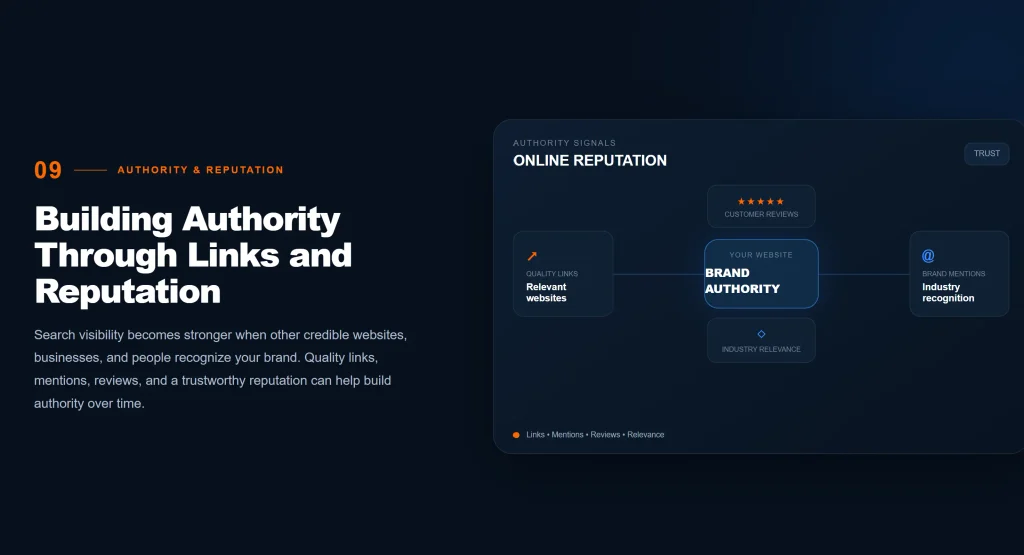
Search visibility is not determined by your website alone.
Links from other websites can help search engines discover your content and can contribute to the authority and reputation of your site.
But this does not mean that more backlinks automatically means better rankings.
A thousand irrelevant or low-quality links are not necessarily more valuable than a few relevant links from trustworthy websites.
A sustainable link-building strategy can include:
- Industry publications
- Relevant business directories
- Partnerships
- Digital PR
- Useful resources
- Original research
- Guest contributions where appropriate
- Business and community relationships
The strongest approach is to create reasons for other websites to mention your business.
For example, an agency might publish original research about digital marketing trends or create a genuinely useful resource that other businesses reference.
Relevance matters
A link from a website that has a genuine relationship to your industry or audience can make much more sense than a random link from an unrelated website.
SEO authority should be built gradually.
The objective isn’t simply:
“How many backlinks can we get?”
It should be:
“How can we build a stronger reputation for this website?”
10. Measuring SEO Performance the Right Way
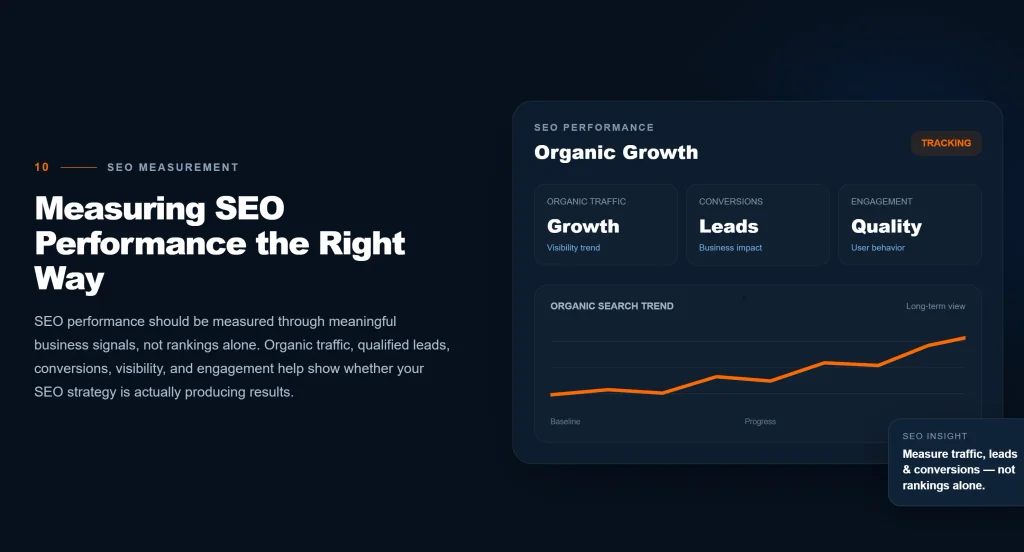
SEO should be measured using more than rankings.
A keyword moving from position 20 to position 10 is useful, but it does not necessarily mean the business is growing.
Businesses should monitor several metrics together.
Organic impressions
Impressions show how often your pages appear in search results.
Increasing impressions can indicate that Google is beginning to associate your website with more searches.
Organic clicks
Clicks show how many people actually visit your website from search.
Click-through rate
CTR helps show how often people choose your result when they see it.
If a page receives many impressions but very few clicks, the title, description, search intent, or positioning may need improvement.
Rankings
Rankings are useful for understanding visibility for important searches, but they should not be the only KPI.
Conversions
This is where SEO connects directly to business.
Depending on the business, conversions might include:
- Contact form submissions
- Phone calls
- WhatsApp inquiries
- Consultation requests
- Purchases
- Bookings
- Leads
Ultimately, the goal isn’t simply to generate traffic.
It is to generate relevant traffic that contributes to business growth.
11. Common SEO Mistakes Businesses Should Avoid
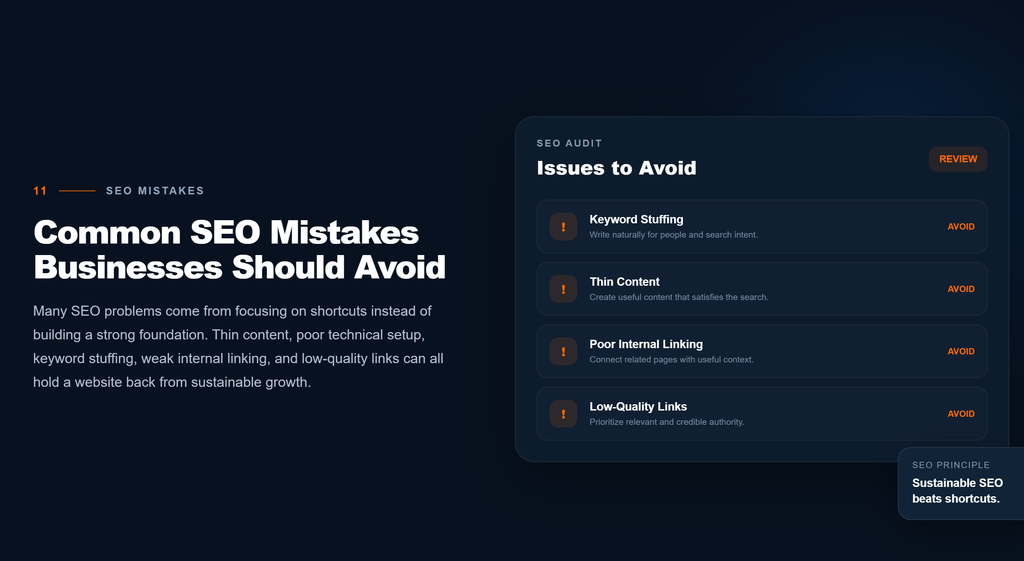
Many businesses spend time and money on SEO but make fundamental mistakes that limit their results.
Keyword stuffing
Repeating the same keyword unnaturally does not make content better.
Write for people first.
Creating thin pages
A page with a few generic sentences rarely provides enough value to compete for meaningful searches.
Publishing duplicate content
Creating several pages with almost identical information can make the website less useful and harder to differentiate.
Ignoring search intent
Ranking for a keyword is not enough if your page does not satisfy what the searcher actually wants.
Buying irrelevant backlinks
Large quantities of unrelated links can create a messy backlink profile without building meaningful authority.
Ignoring technical problems
Broken links, indexing issues, incorrect canonical tags, poor mobile usability, and other technical problems can prevent good content from performing.
Expecting instant results
SEO is usually a long-term process.
Some changes can produce relatively quick improvements, while building authority and strong organic visibility can take considerably longer.
Focusing only on rankings
A number-one ranking is valuable only when it attracts the right audience and contributes to business goals.
12. Building a Long-Term SEO Strategy
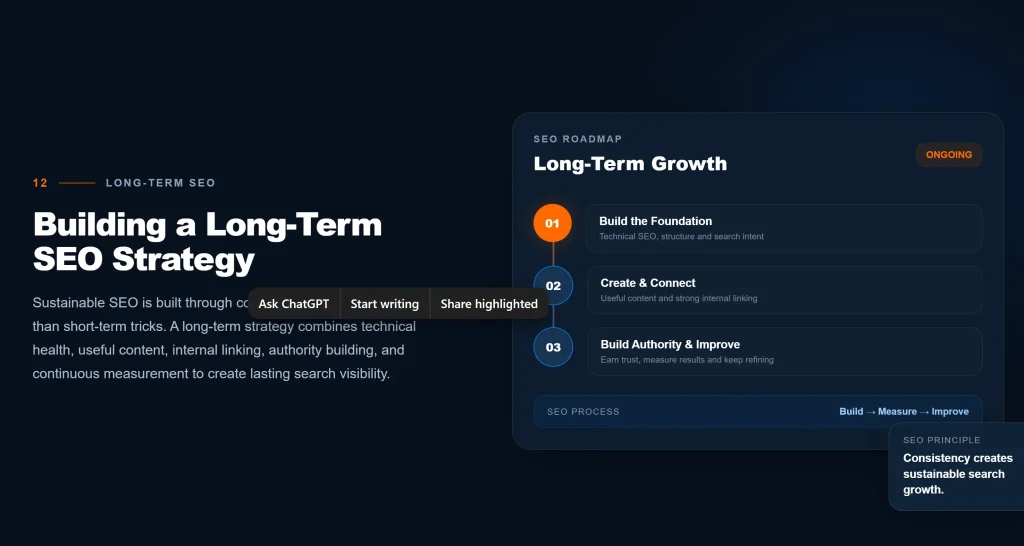
The strongest SEO strategies are not built around one optimization.
They are built around continuous improvement.
A practical long-term approach might look like this:
Start with the foundation
Make sure your important pages are accessible, technically sound, properly structured, and clearly communicate what your business offers.
Identify valuable search opportunities
Research the searches your customers use and understand the intent behind them.
Build useful pages
Create service pages and supporting content that genuinely answer those searches.
Connect your content
Use internal links to create relationships between your homepage, services, and educational content.
Strengthen local visibility
If your business serves a specific location, build genuine local relevance across your website and business profiles.
Build authority
Earn relevant mentions, links, and recognition from websites and organizations that matter to your industry.
Measure and improve
Use search and website data to identify what is working and what needs improvement.
SEO should therefore be viewed as a cycle:
Research → Create → Optimize → Connect → Measure → Improve
Then repeat.
SEO Is a Business Strategy, Not Just a Ranking Strategy
The biggest mistake businesses can make is treating SEO as a checklist.
Adding keywords, changing titles, publishing a few articles, and building some backlinks does not automatically create a successful SEO strategy.
The real objective is to build a website that deserves to be visible.
That means understanding your customers, creating genuinely useful information, making your website technically accessible, building authority, and continuously improving based on evidence.
When these elements work together, SEO can become more than a source of website traffic.
It can become a long-term acquisition channel for the business.
businesses looking for professional SEO services can help build and manage a search strategy around the business’s goals, audience, and market.
And if you’re looking at SEO as part of a broader digital strategy, our Digital Marketing Guide explores how SEO, Google Ads, social media, websites, and other channels can work together.
SEO is not about doing more. It’s about building something better, making it easier to discover, and improving it consistently over time.