

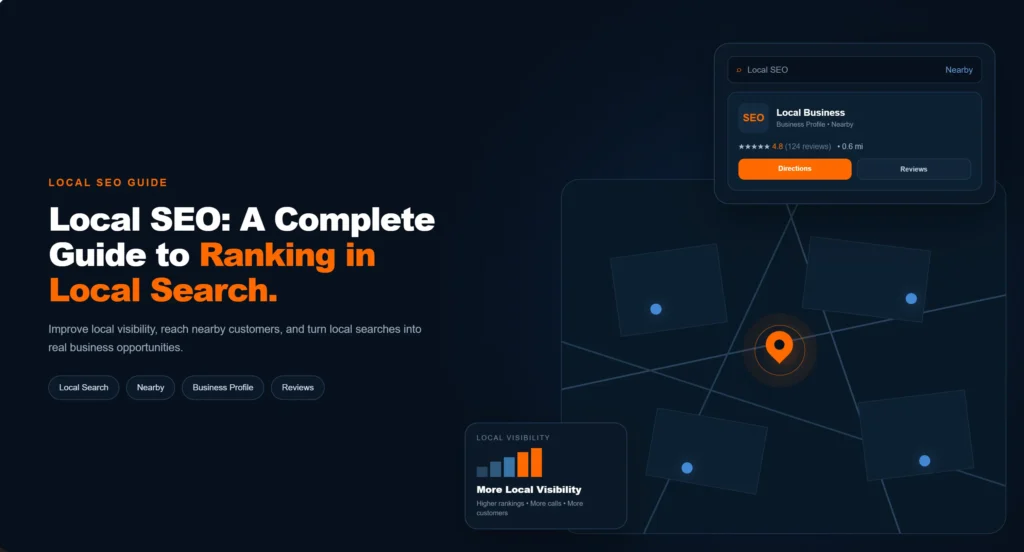
Local customers are often searching for businesses at the exact moment they need a product or service. Whether someone searches for a restaurant nearby, a marketing agency in their city, a dentist near them, or a local home service provider, search engines use location and relevance to help connect that person with nearby businesses.
Local SEO helps businesses improve their visibility in these location-based searches. It combines website optimization, Google Business Profile optimization, local content, citations, reviews, and other strategies to help a business become more visible to customers in its target area.
For businesses that depend on customers from a specific city, region, or service area, Local SEO can be an important part of a broader digital marketing strategy.
Search engines need to understand what the business offers, where it operates, and how relevant it is to a particular search. They also need consistent and trustworthy information across the business website and other online platforms.
Customers also need enough information to feel confident choosing that business.
That is why effective Local SEO involves more than adding a city name to a website or creating a Google Business Profile. It involves aligning the website, local content, business information, reviews, citations, links, and technical foundation around the areas and services the business actually serves.
In this guide, we’ll break down how Local SEO works, what influences local search visibility, how businesses can optimize their website and Google Business Profile, and how to measure whether their local search strategy is producing meaningful results.
What Is Local SEO?
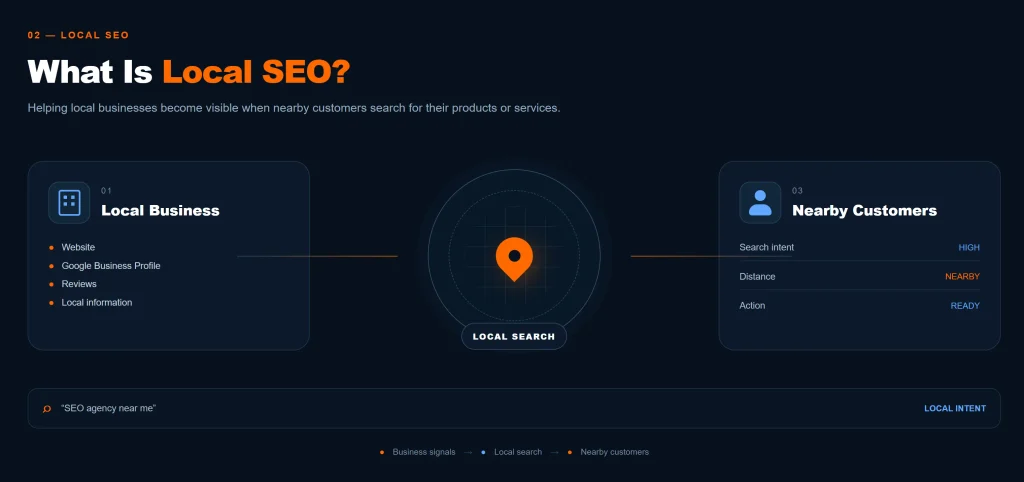
Local SEO is the process of optimizing a business’s online presence to improve its visibility in searches connected to a specific geographic location.
Traditional SEO can target searches from users anywhere in the world, while Local SEO focuses on searches where location is an important part of the user’s intent.
For example, a person searching for:
- SEO agency
- SEO agency in Lahore
- SEO agency near me
- local SEO services in Lahore
may have very different search intent. The last three searches contain stronger local intent because the user is looking for a business that serves a particular area.
Local SEO can apply to businesses with physical locations as well as businesses that serve customers within specific geographic areas. Depending on the business, local search visibility may involve Google Maps, local organic results, location-specific service pages, business listings, and other signals that help search engines connect the business with relevant searches.
For example, a restaurant with a physical location may want to appear when people search for restaurants nearby, while a plumbing company may serve several areas without having a storefront that customers visit. Both businesses can benefit from local search visibility, but their optimization approach may be different.
Local SEO helps businesses communicate their location, services, relevance, and credibility to search engines and potential customers. This involves more than simply adding a city name to a page. The website, business information, customer reviews, local content, and other online signals should accurately represent what the business offers and where it operates.
For businesses that need help improving their visibility in local search, our Local SEO Services provide a more comprehensive approach to local search optimization.
How Does Local Search Work?
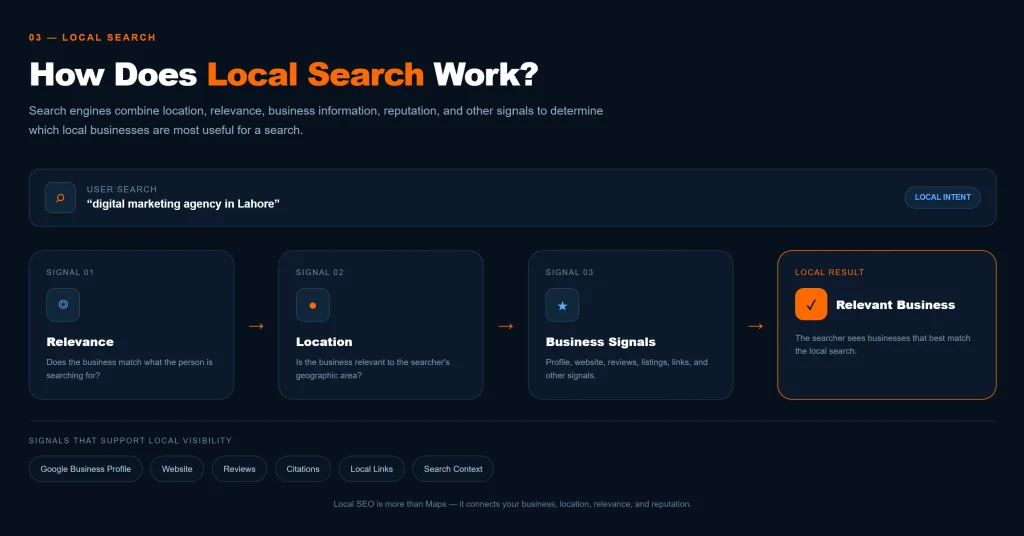
When someone performs a local search, Google uses different types of information to determine which businesses are relevant to the query. The search engine needs to understand what the person is looking for, which businesses are relevant to that need, and where those businesses operate or serve customers.
Important factors can include:
- The relevance of the business to the search query
- The business’s physical location or service area
- The products and services the business provides
- Information in its Google Business Profile
- Content and location information on the business website
- Business information across relevant directories and platforms
- Customer reviews and reputation signals
- Links and mentions from other relevant websites
- The user’s search context and location
- The relationship between the business, its services, and the areas it serves
For example, someone searching for “SEO agency” may receive broader results, while a search such as “SEO agency in Lahore” gives a much stronger geographic signal. A search for “SEO agency near me” adds another layer of location context. Search engines can use the user’s location and search context to determine which businesses may be relevant nearby.
However, local search is not simply about matching a city name with a keyword. Search engines need to understand the meaning and context of the business information. A website should clearly explain what the business does, which services it offers, which customers it serves, and which locations or service areas it covers.
For example, a company that provides plumbing services in Lahore should clearly communicate that it provides plumbing services, describe the relevant services it offers, and accurately explain the areas it serves. This gives both users and search engines clearer information about the business and its relevance to local searches.
Local search results can appear in several places, including Google Maps, local search features, and traditional organic search results. The type of result shown can depend on the search query, the user’s location, and the information available about relevant businesses.
This is why businesses should not treat Local SEO as simply “ranking a Google Business Profile.” A strong local presence usually requires consistent and useful information across the business website, Google Business Profile, relevant listings, local content, reviews, links, and other online sources.
The goal is to create a clear digital presence where the business, its services, its locations, and its customer information are easy to understand. When these signals accurately represent the real business, search engines have more useful information to evaluate its relevance for local searches.
Why Is Local SEO Important for Businesses?
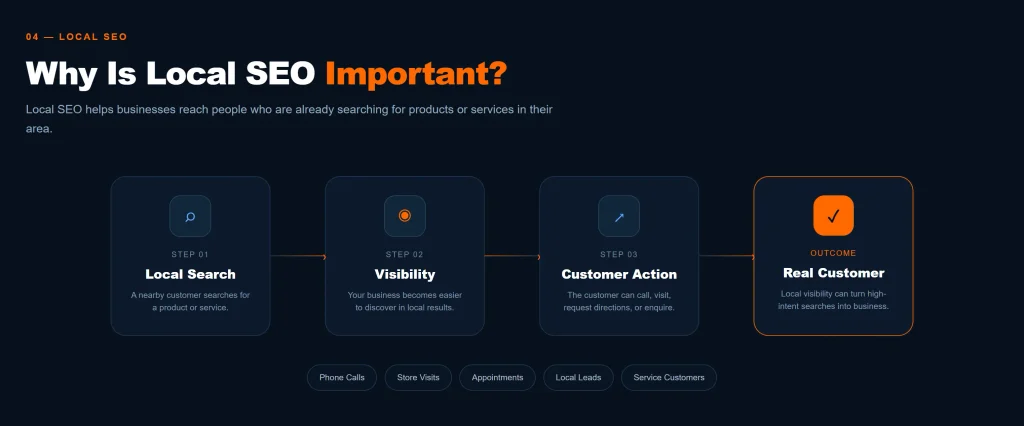
Local SEO can help businesses reach people who are already looking for products or services in their area.
Consider someone searching for “plumber in Lahore.” They are not simply researching what a plumber does. They may be looking for a business they can contact, compare, or hire. This makes local search especially valuable because the search can happen close to the point where a customer is ready to take action.
The same applies to searches such as:
- Restaurant near me
- Dentist in Lahore
- Digital marketing agency in Lahore
- Real estate agent near me
- AC repair service in Lahore
- Clothing store near me
These searches show a clear connection between the customer’s need, the type of business they want, and the location they are searching in.
Local search can be particularly valuable for businesses that depend on:
- Phone calls
- Local appointments
- Store visits
- Service-area customers
- Local leads
- Location-specific purchases
- In-person consultations
- Requests for quotes or estimates
For these businesses, appearing when a potential customer is actively searching can create an opportunity to generate a lead or sale without relying entirely on broad advertising or general website traffic.
Local visibility can also help customers evaluate a business before contacting it. Searchers may look at the business’s services, location, opening hours, website, reviews, photos, and other available information before deciding which business to choose.
This means Local SEO is not only about getting more people to see a business. It is also about making the information they find useful and trustworthy enough to support a decision.
Local SEO can also benefit smaller businesses competing against larger companies. A large company may have greater overall brand recognition, but a smaller business with a strong presence in its actual service area can still become visible when customers perform geographically focused searches.
For example, a local agency may not need to compete nationally for every search related to digital marketing. It may be more valuable to become highly relevant for searches from businesses looking for digital marketing services in the specific cities or regions the agency actually serves.
However, visibility alone does not guarantee business growth. The website, business profile, reviews, services, contact information, and customer experience all play a role in what happens after someone discovers the business.
A successful local strategy therefore connects search visibility with the next step in the customer journey—whether that means making a phone call, visiting a location, requesting information, booking an appointment, submitting a form, or making a purchase.
For businesses that rely on customers from specific geographic areas, this makes Local SEO an important part of a broader digital marketing strategy.
Google Business Profile and Local SEO
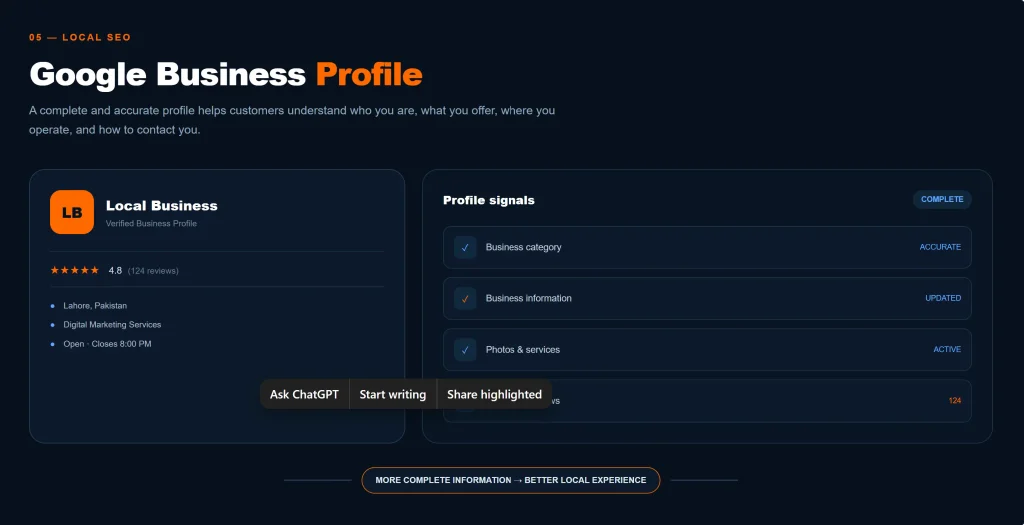
Google Business Profile is an important part of Local SEO for many local businesses. It allows businesses to provide Google with structured information about who they are, what they offer, where they operate, and how customers can contact them.
A properly managed profile can provide potential customers with information such as:
- Business name
- Primary and secondary categories
- Address or service area
- Phone number
- Website
- Business hours
- Services
- Photos
- Reviews
- Other business information
This information can help customers understand a business before they visit its website, call, request directions, or make an enquiry. For businesses with physical locations, the profile can also play an important role in how they appear in Google Maps and other local search experiences.
Businesses should provide information that accurately represents their real-world operations. The business name, category, address, service area, opening hours, website, and contact details should all be kept up to date.
Choosing the right business category is also important because it helps describe the primary type of business being represented. Businesses should select categories that accurately match what they actually provide rather than choosing unrelated categories simply because they appear popular.
The services listed on a profile should also reflect the services the business genuinely offers. For example, a digital marketing agency might list services such as SEO, Google Ads management, social media marketing, and website development if those are actual services provided by the company.
Photos and customer reviews can provide additional information for people evaluating a business. Businesses should use genuine photos that represent their location, team, products, services, or other relevant aspects of the business. Reviews should be managed professionally, with genuine customers encouraged to share honest feedback.
It is also important to keep the information on the profile consistent with the business website and other important online listings. Major differences in the business name, contact information, address, services, or operating details can confuse customers and create inconsistent information across the web.
Google Business Profile should therefore be treated as one part of a broader local presence rather than the entire Local SEO strategy. The profile works alongside the business website, local content, citations, reviews, links, and other relevant signals that help establish what the business does and where it operates.
For businesses that need professional help with this area, GMB Optimization Services can be used as the commercial next step.
Local Keyword Research
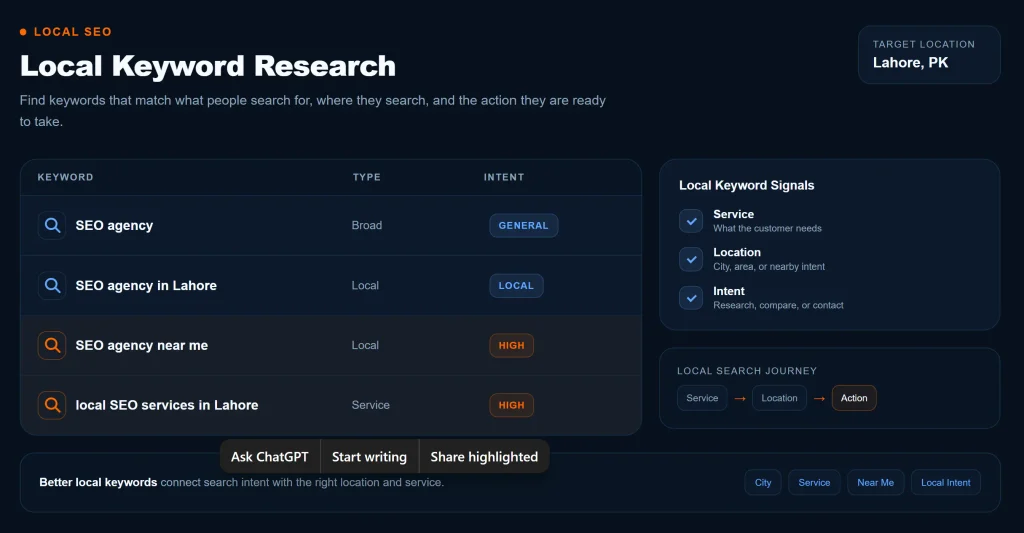
Local keyword research identifies the terms potential customers use when searching for a business, product, or service in a particular location.
For example, a marketing agency could investigate searches such as:
- digital marketing agency in Lahore
- SEO services in Lahore
- local SEO agency Lahore
- Google Business Profile optimization Lahore
- SEO company near me
- digital marketing services Lahore
These searches can contain different levels of local and commercial intent. Someone searching for “SEO services in Lahore” is likely looking for a service provider, while someone searching for “what is local SEO” may still be researching the topic rather than looking for a company.
Understanding this difference is important because the goal of keyword research is not simply to collect keywords. It is to understand what the searcher wants and what type of result would actually satisfy that search.
Local keyword research should therefore consider several elements:
- What customers are searching for: Identify the products, services, questions, and problems that matter to the target audience.
- Which services they need: Separate different services instead of treating every search as the same topic.
- Which locations matter to the business: Identify the cities, regions, neighborhoods, or service areas the business genuinely serves.
- Whether the search has local intent: Determine whether the searcher is looking for a nearby business, a specific location, or general information.
- What type of page should satisfy the search: Decide whether the best result should be a service page, location page, blog article, homepage, or another relevant page.
Location modifiers can also appear in different forms. A searcher might include a city name, use terms such as “near me,” mention a neighborhood, or search for a service together with a broader region. Businesses should consider these variations when planning their content instead of creating a separate page for every minor keyword variation.
For example, a business targeting Lahore might have a service page focused on SEO Services in Lahore, while a separate educational article could explain how SEO works for businesses. These pages can serve different search intents while supporting the same broader topic.
A service page, location page, blog article, and Google Business Profile may therefore target different parts of the customer journey. Keyword research helps determine which topics belong on each part of the website and prevents businesses from forcing every local keyword onto a single page.
The most useful keyword strategy is ultimately based on relevance and search intent, not simply the number of times a location name can be added to a page. Keywords should be incorporated naturally into useful content that clearly explains the business, its services, and the locations it actually serves.
On-Page Local SEO
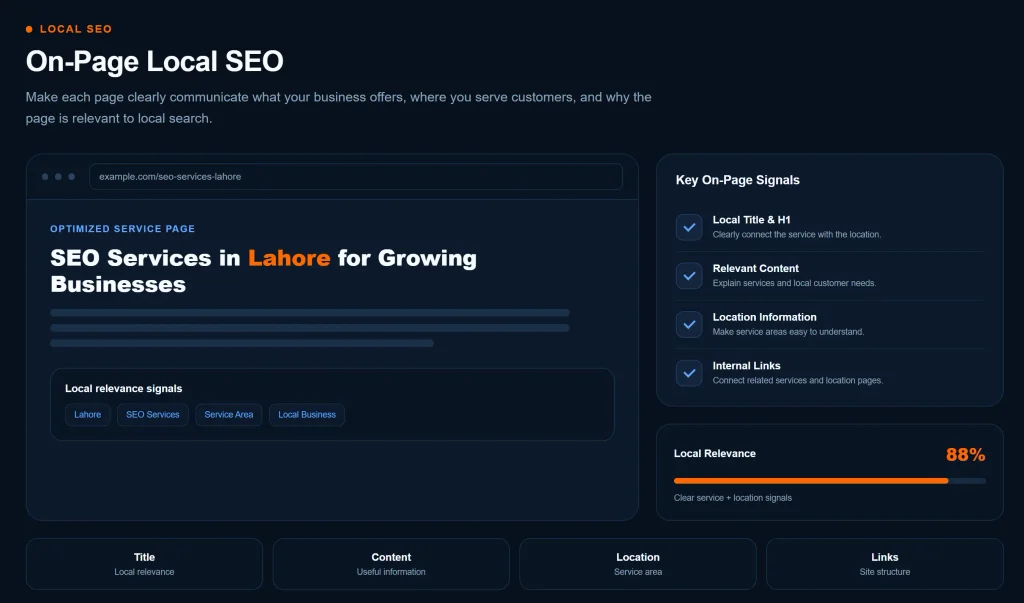
A business website should clearly communicate what the business does, which services or products it provides, and where it operates. This helps visitors understand the business while giving search engines clearer information about the page.
Important on-page elements can include:
- Page titles
- Headings
- Service descriptions
- Location information
- Contact information
- Internal links
- Relevant local content
- Structured data where appropriate
- Clear calls to action
Page titles and headings should accurately describe the subject of the page. If a business provides SEO services in Lahore, for example, the relevant service page can clearly communicate both the service and location rather than relying on vague wording.
Service and location information should also be useful rather than simply repeating keywords. A good local page can explain what the business offers, who it serves, which areas it covers, and how customers can contact or work with the business.
Internal linking is another useful part of on-page optimization. Related service pages, location pages, and educational content can link to one another where relevant. This helps visitors discover related information and creates clearer relationships between pages on the website.
Structured data can also be used where appropriate to provide search engines with additional information about the business, organization, services, or other entities represented on a page. The information should accurately reflect the content visible to users.
For example, a business serving Lahore should make its service area clear where it is genuinely relevant rather than hiding its location from both users and search engines.
Local optimization should still prioritize readability. Repeating a city name unnaturally throughout a page can make the content worse for users rather than better. The goal is to create useful pages that naturally explain the business, its services, its location, and the value it provides to local customers.
Location Pages for Multi-Location Businesses
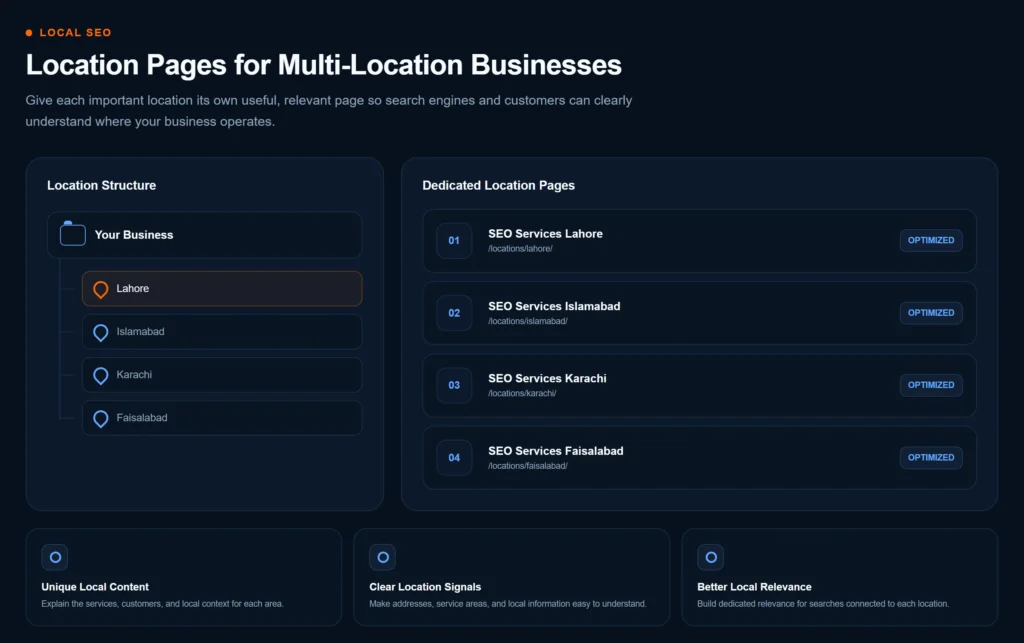
Businesses operating in multiple cities or regions may need dedicated location pages to clearly explain where their services are available.
A location page can help a business provide information specifically for customers in a particular city or service area. For example, a company serving Lahore, Islamabad, and Karachi may create separate pages that explain its services and presence in each location.
A useful location page should provide genuinely valuable information about that location rather than changing only the city name on an existing template.
A strong location page might include:
- Services available in that area
- The business’s relationship with the location
- Relevant service information
- Local contact details where applicable
- Nearby service areas
- Useful location-specific information
- Relevant customer questions
The content should accurately reflect what the business actually offers in that area. If a company provides different services, has different operating hours, or serves different areas from one location to another, those differences should be explained rather than hidden behind an identical template.
Location pages can also work as part of the website’s internal linking structure. Relevant service pages, location pages, and supporting content can link to each other where useful, helping customers move between information about the service and the areas where it is available.
The key is unique value. Creating dozens of nearly identical pages with only the location name changed can produce a poor user experience and add little useful information. Each page should exist because it provides something genuinely relevant to customers in that location.
For businesses with only one service area, a dedicated page for every nearby city is not automatically necessary. Location pages should be created based on the business’s actual service coverage and whether each location deserves useful, specific information.
Local Citations and NAP Consistency
What Is a Local Citation?
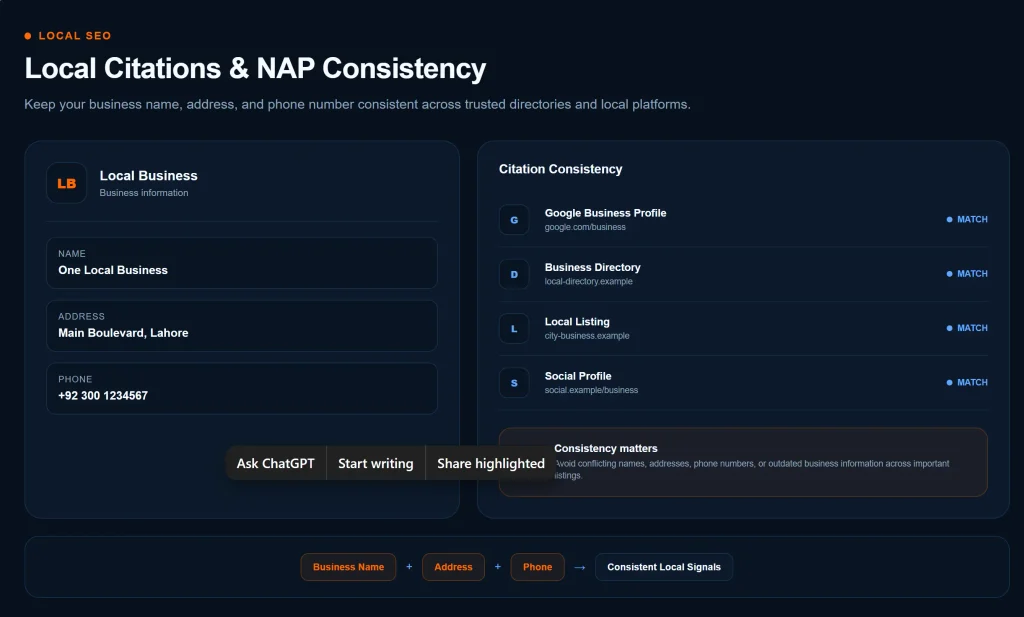
A local citation is a mention of a business’s information on another website, directory, platform, or relevant online source.
Depending on the type of business, citations may appear on business directories, industry websites, local organizations, review platforms, or other relevant websites. These mentions can help establish connections between a business and its industry or geographic area.
What Does NAP Mean?
NAP refers to:
Name, Address, Phone number
These details help identify a business and connect its online presence across different sources.
Why NAP Consistency Matters
Businesses should aim to keep their core business information accurate and consistent across important platforms. This includes the official business name, address, phone number, website, and other important details where applicable.
For example, if a business has changed its phone number or moved to a new address, important listings should be updated rather than leaving old information across multiple websites. Customers who find conflicting information may be unsure which details are correct.
Consistency does not mean every listing has to contain exactly the same amount of information. Different platforms may provide different fields and formats. The important point is that the core business information accurately represents the real business.
Quality Over Quantity
A relevant industry directory or local business organization may provide more useful context than a large number of unrelated websites.
Businesses should therefore focus on quality, relevance, and accuracy, not simply creating the largest possible number of listings. Submitting a business to hundreds of low-quality directories can add little value, while maintaining accurate information on important and relevant platforms can provide a stronger foundation for local search visibility.
Regularly reviewing important citations can also help identify outdated information, duplicate listings, incorrect contact details, or other inconsistencies that could confuse customers.
Reviews and Online Reputation
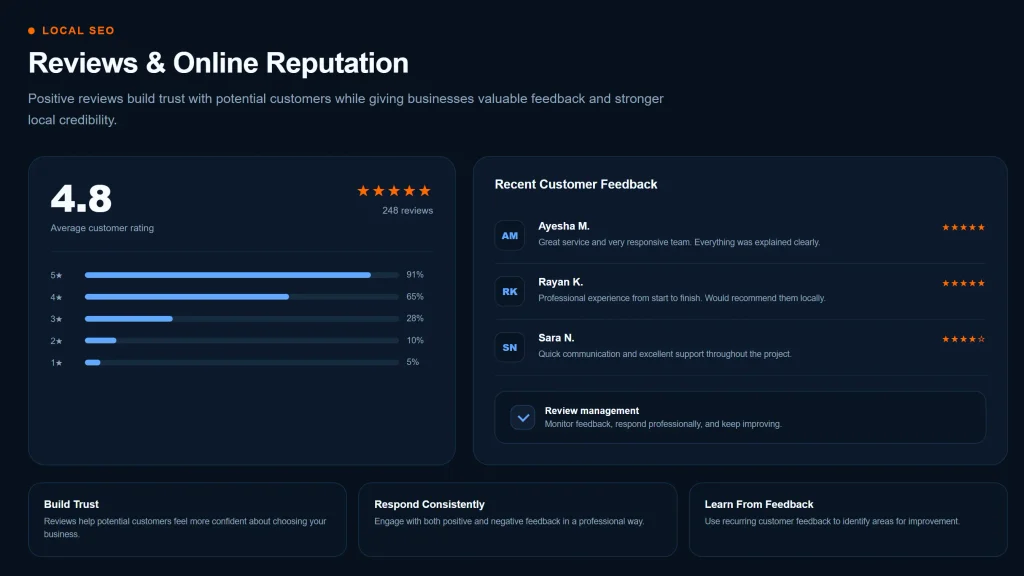
Reviews are an important part of how potential customers evaluate local businesses. When people find a business through search or Google Maps, reviews can help them decide whether the business appears trustworthy and suitable for what they need.
Why Reviews Matter
Reviews provide real customer experiences that can give potential customers additional context about a business. A business with useful, genuine feedback may give people more confidence when deciding whether to make a call, visit a location, request a quote, or purchase a product or service.
Reviews can also provide search engines with additional information about how customers describe their experiences with a business. However, businesses should focus on providing a good customer experience rather than trying to manipulate review signals.
Managing Customer Reviews
Good review management includes:
- Asking real customers for honest reviews
- Responding professionally to positive and negative feedback
- Addressing legitimate complaints
- Keeping communication respectful
- Monitoring the business’s reputation across relevant platforms
Responses should be helpful and appropriate to the situation. A negative review does not always need to be treated as something to remove or hide. Responding professionally and attempting to resolve legitimate concerns can demonstrate that the business takes customer feedback seriously.
Avoiding Fake or Misleading Reviews
Businesses should never rely on fake reviews, purchased reviews, review manipulation, or misleading practices to artificially improve their reputation.
The goal should be to build a genuine collection of customer feedback over time. Businesses can make the process easier by asking customers for honest feedback after a genuine interaction or completed service.
Reviews are therefore not simply a rating to improve. They are part of the broader reputation of a business and can influence how potential customers evaluate the company before deciding to contact or purchase from it.
Local Link Building
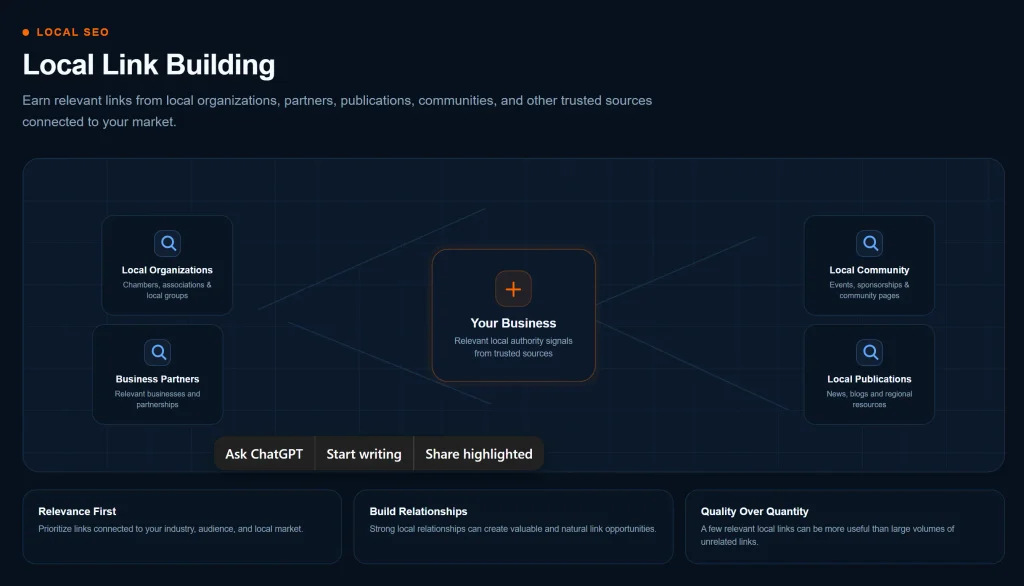
Links from relevant websites can contribute to a business’s overall authority and help establish connections between the business, its industry, and its geographic market.
What Makes a Local Link Valuable?
For Local SEO, relevance is particularly important. A link from a relevant local organization, industry publication, business association, or community website can provide more useful context than a link from an unrelated website created only for SEO purposes.
Potential opportunities may include:
- Local organizations
- Industry publications
- Local news websites
- Business associations
- Community organizations
- Relevant partnerships
- Local sponsorships
- Useful local resources
The best opportunities are usually connected naturally to the business. For example, a local business may earn a mention from an industry association, local publication, community organization, or relevant partner because of an actual relationship or useful contribution.
Focus on Relevance and Quality
The goal should not be collecting hundreds of unrelated backlinks. A large number of low-quality or irrelevant links does not replace genuine, relevant authority.
A smaller number of relevant, legitimate mentions can be more useful than a large collection of unrelated links. Link building should therefore focus on earning genuine references from websites that make sense for the business, its industry, or its local market.
Local Content Strategy
Local businesses can also use content to answer questions from customers in their target market and demonstrate useful knowledge about their services.
For example, a digital marketing agency could create content about:
- SEO for businesses
- Digital marketing for local companies
- Google Business Profile optimization
- Local search strategies
- Common SEO mistakes
- Marketing challenges faced by businesses in a particular market
The content should be based on real customer questions and relevant topics rather than simply adding city names to existing articles.
Local content can also support the rest of the website through internal links. An educational article can link to a relevant service page, while service pages can link to useful guides that answer common customer questions.
This type of content can support the site’s broader topical authority while giving potential customers useful information before they contact the business.
For a broader introduction to SEO and its role in business growth, see our SEO for Businesses guide.
Technical SEO for Local Businesses
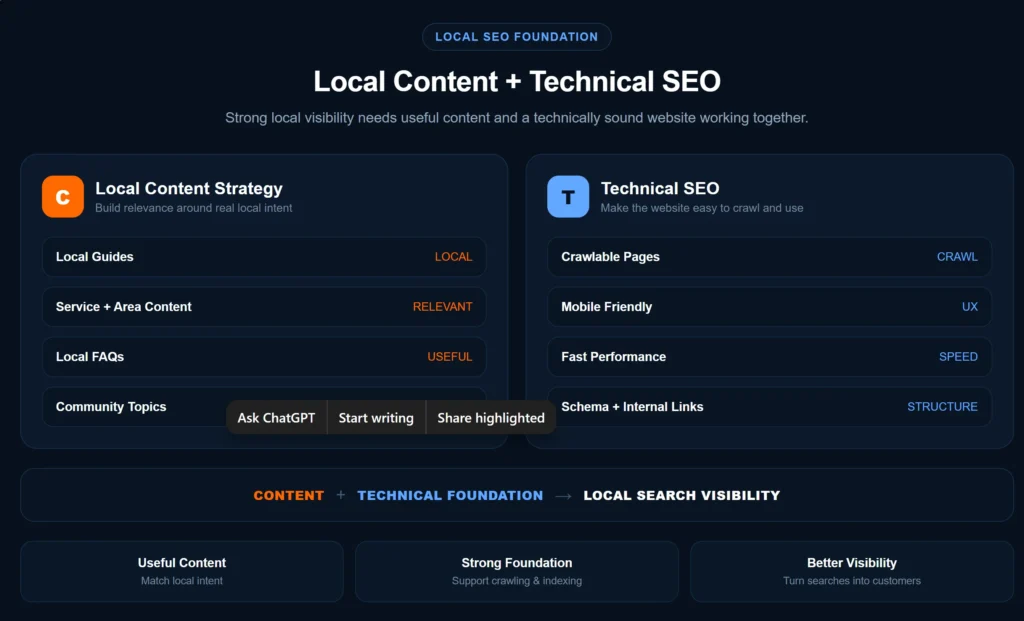
Local SEO still depends on a technically sound website. Even when a business has strong local information and an optimized Google Business Profile, technical problems can make it harder for search engines to crawl, understand, and index the website.
Important Technical Areas
Important areas include:
- Mobile usability
- Page speed
- Crawlability
- Indexability
- Internal linking
- HTTPS
- Clear site structure
- Descriptive page titles
- Proper heading structure
- Structured data where appropriate
A website should work well across different devices and allow visitors to reach important information without unnecessary difficulty. Important service and location pages should also be accessible through a logical site structure and internal links.
Search engines need to be able to discover and process these pages. Problems such as blocked pages, incorrect indexing settings, broken links, or unclear website structures can make it harder for search engines to discover and process important content.
Technical SEO and Local Content
Technical optimization also supports the local content itself. A location page, service page, or local guide is only useful if search engines can access and index it correctly.
Structured data can also be used where appropriate to provide additional information about the business or other entities represented on a page. It should accurately describe the visible content rather than being used to add misleading information.
A business can have a well-optimized Google Business Profile, but a poor website can still create problems for users and limit the overall search experience.
Local SEO should therefore work alongside broader SEO Services rather than being treated as a completely separate discipline.
How to Measure Local SEO Performance
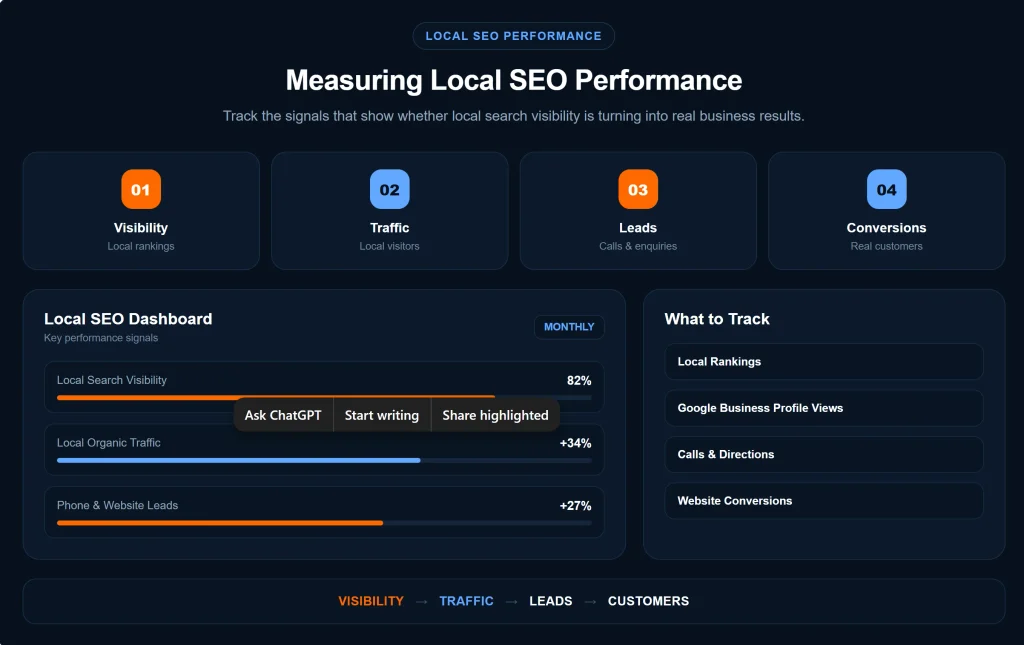
Local SEO should be measured using meaningful search and business metrics. Tracking these metrics helps a business understand whether its local visibility is improving and whether that visibility is actually contributing to customer enquiries and sales.
Important Local SEO Metrics
Depending on the business, useful measurements can include:
- Local search visibility
- Google Maps visibility
- Organic traffic
- Local keyword rankings
- Website enquiries
- Phone calls
- Direction requests
- Form submissions
- Leads
- Conversions
- Review growth
The most useful metrics depend on how the business gets customers. A restaurant may care about direction requests and phone calls, while a service business may focus more heavily on form submissions, calls, and qualified leads.
Rankings Are Not the Whole Picture
Local keyword rankings can show whether a business is becoming more visible for particular searches, but rankings alone do not tell the entire story.
A business could improve its position in search results while receiving few enquiries. On the other hand, a business may generate valuable customers from a smaller number of highly relevant searches.
This is why visibility should be considered alongside traffic and customer actions.
Connecting Search Visibility to Business Results
The ultimate purpose of Local SEO is not simply to increase rankings. It is to help the right customers discover the business and take meaningful actions.
For example, a business can monitor whether increases in local visibility are followed by more website visits, phone calls, quote requests, bookings, store visits, or other relevant conversions.
Review growth and customer feedback can also provide useful context when evaluating the overall local presence.
By comparing these measurements over time, businesses can identify which parts of their local strategy are producing useful results and where further optimization may be needed.
Common Local SEO Mistakes
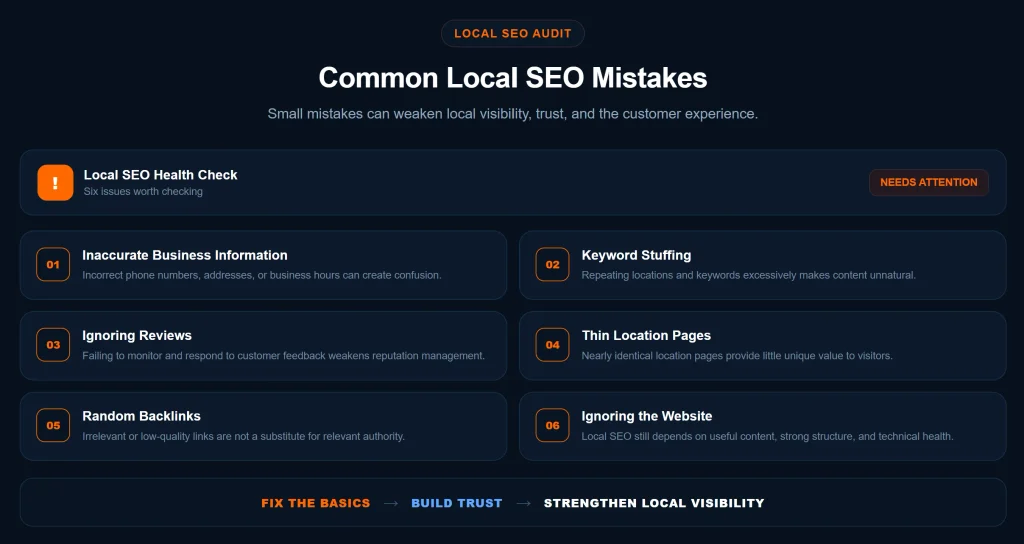
Some common mistakes can weaken a local SEO strategy or create a poor experience for potential customers.
1. Inaccurate Business Information
Incorrect phone numbers, addresses, business hours, service areas, or other important information can create confusion. Businesses should regularly check important profiles and listings to make sure customers can find accurate information.
2. Keyword Stuffing
Repeating the same location and keywords excessively makes content unnatural and does not create a better experience. Local keywords should be used where they genuinely describe the subject of the page.
3. Ignoring Reviews
Businesses that never monitor or respond to customer feedback miss an important part of their online reputation. Genuine reviews can help potential customers evaluate a business, while professional responses can show that the business takes customer feedback seriously.
4. Creating Thin Location Pages
Making dozens of pages with almost identical content provides little value. A location page should contain useful information that is genuinely relevant to customers in that area. Businesses should avoid creating pages for locations they do not actually serve simply to target additional searches.
5. Building Random Backlinks
Large quantities of irrelevant or low-quality links are not a substitute for relevant authority. Link building should focus on legitimate opportunities that are relevant to the business, its industry, or its local market.
6. Ignoring the Website
Local SEO is not only about Google Maps. The website still needs useful content, good structure, accessible service and location information, internal links, and a strong technical foundation.
Avoiding These Mistakes
A strong local strategy should focus on accuracy, relevance, usefulness, and consistency rather than trying to manipulate individual ranking signals. Businesses should regularly review their website, business information, reviews, local content, and important listings to identify areas that need improvement.
Local SEO vs. Traditional SEO
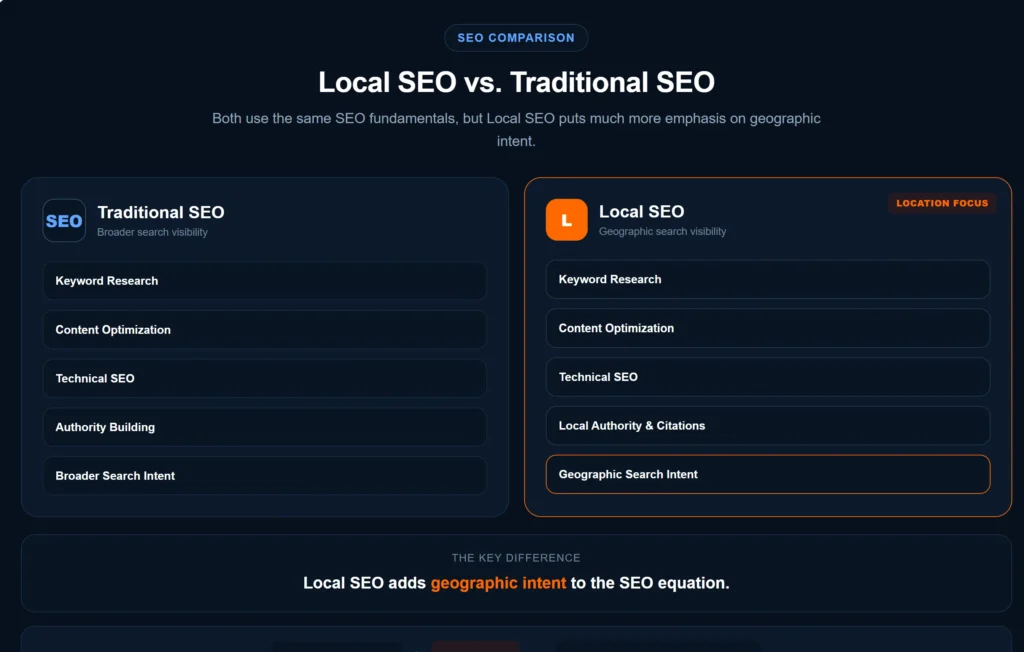
Local SEO and traditional SEO share many fundamentals, including:
- Keyword research
- Content optimization
- Technical SEO
- Internal linking
- Authority building
- Search intent
The major difference is the importance of geographic intent and the type of audience a business is trying to reach.
Traditional SEO
Traditional SEO can target searches from a much broader audience. A website may try to reach users across an entire country, multiple countries, or even worldwide, depending on the business and its goals.
For example, an article about “how SEO works” could attract readers from many different locations because the topic does not require a specific geographic area.
Local SEO
Local SEO focuses more heavily on searches connected to a particular location or service area. The goal is to help businesses become more visible when potential customers are looking for relevant products or services in the areas the business actually serves.
For example, “SEO agency in Lahore” has a much stronger geographic intent than “what is SEO?” because the searcher is looking for a service provider within a specific location.
Local SEO can also involve business profiles, local citations, reviews, location pages, and other signals that are less central to a broad SEO strategy.
Using Both Strategies Together
Local SEO and traditional SEO do not have to be separate strategies. For many businesses, the strongest approach combines both.
A company can use traditional SEO to build broader visibility through useful educational and service content while using Local SEO to reach customers searching for its services in specific cities or service areas.
The right balance depends on the business model, target audience, and geographic coverage. A local restaurant may rely heavily on local visibility, while a software company serving customers worldwide may place more emphasis on broader SEO.
When Should a Business Invest in Local SEO?
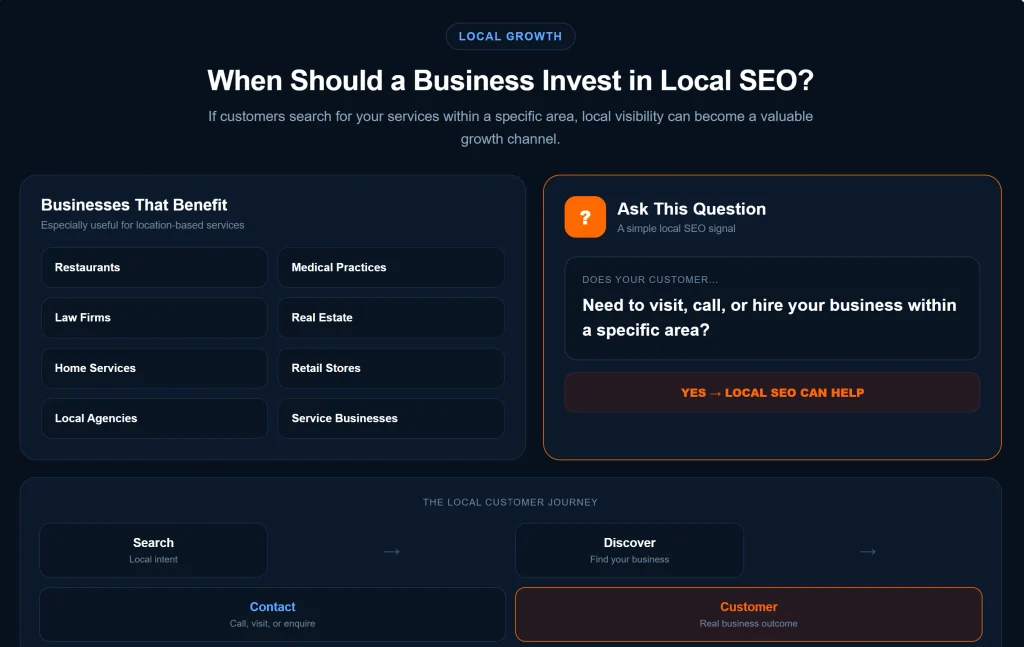
Local SEO is especially relevant for businesses that serve customers within a defined geographic area. If a customer’s location affects where they can purchase, visit, book, or receive a service, local search visibility can be an important part of the business’s marketing strategy.
Businesses That Can Benefit From Local SEO
This can include:
- Restaurants
- Medical practices
- Law firms
- Real estate companies
- Home service businesses
- Retail stores
- Professional service providers
- Local agencies
- Service-area businesses
The approach can vary depending on how the business operates. A restaurant may focus on customers visiting a physical location, while a home service company may serve customers across several areas without having a storefront. Both can benefit from being visible when people search for relevant services nearby.
When Local Search Matters Most
Local SEO can be particularly valuable when customers are likely to search for a business before taking action. This can include searches for a nearby product or service, a business in a specific city, a professional serving a particular area, or a company that can visit the customer’s location.
If customers need to visit the business, call the business, book an appointment, request a quote, or hire it within a specific region, improving local search visibility can help connect the business with relevant potential customers.
However, Local SEO does not need to be treated as a completely separate marketing strategy. It can work alongside broader SEO, content marketing, paid advertising, and other digital marketing activities.
For businesses ready to build a stronger local presence, Local SEO Services can provide a more comprehensive approach covering areas such as local keyword research, Google Business Profile optimization, citations, reviews, and location-focused on-page SEO.